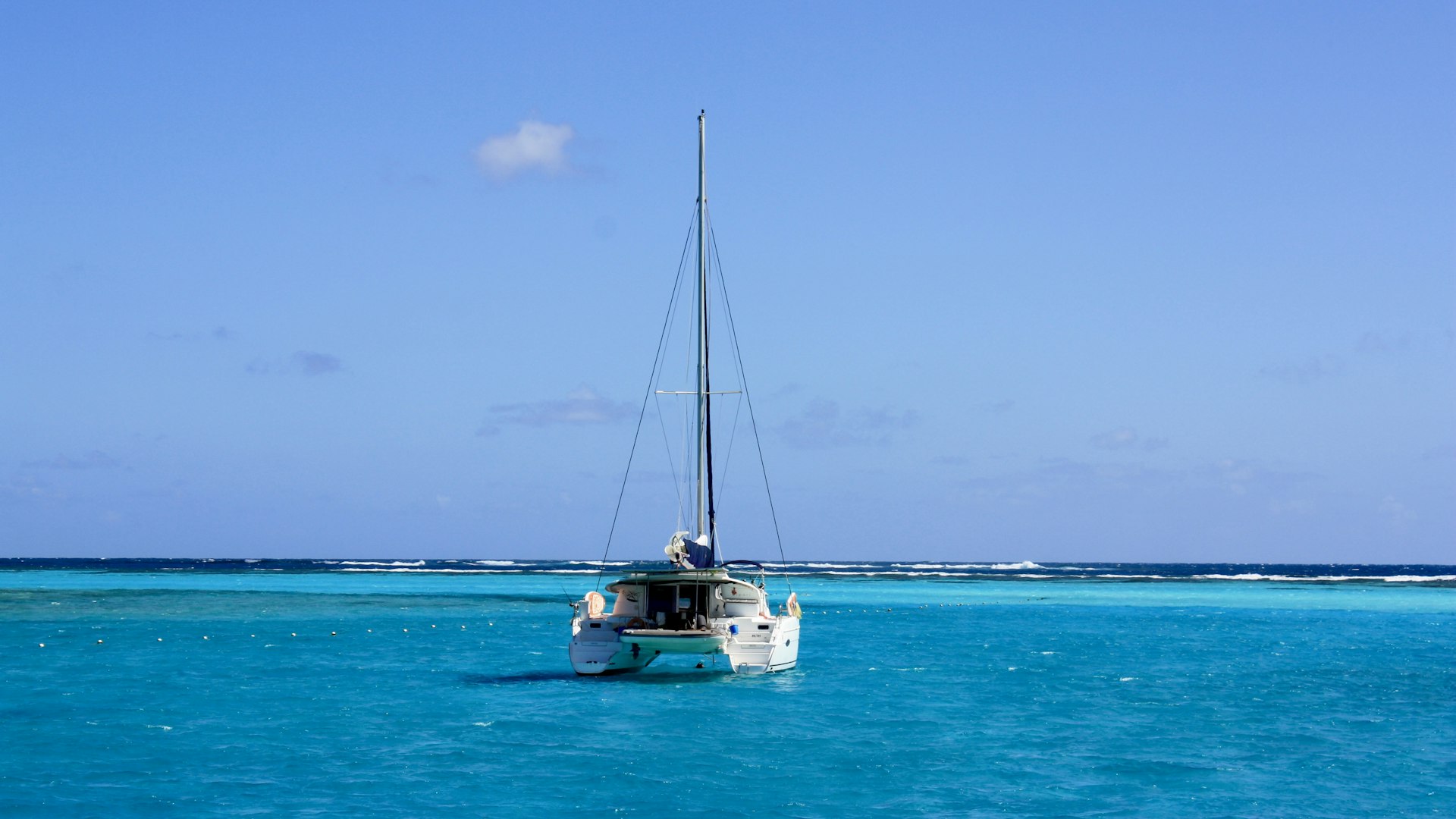
Catamaran Charters
From the trade-wind reaches of the Caribbean to the glassy channels of French Polynesia, a catamaran charter redefines what it means to live aboard — generous deck space, shallow draught, and a stability underfoot that transforms a week at sea into something closer to a floating villa.
Featured Catamarans

Crewed Catamaran BELLAMAGGIO
Fountaine Pajot Salina 48
From
$1k/week

Bareboat Sailing Yacht Hanse 345
Hanse 435 · 2012
From
€1k/week

Crewed Sailing Catamaran LAGOON 380
Lagoon 380
From
€1k/week

Bareboat Catamaran Lagoon 410
Lagoon 410
From
€2k/week

Crewed Catamaran Cat 23
Custom Built · 2005
From
€2k/week

Bareboat Catamaran Lagoon 39
Lagoon 39 · 2016
From
€2k/week

Bareboat Catamaran Lagoon 400
Lagoon 400 · 2011
From
€2k/week

Bareboat Catamaran Lagoon 400
Lagoon 400 S2 · 2012
From
€2k/week

Bareboat Catamaran Lagoon 380
Lagoon 380 · 2015
From
€2k/week

Bareboat Sailing Yacht MAGIA VERA
Bavaria 40
From
€2k/week

Bareboat Sailing Yacht HONG KONG
Bavaria 40
From
€2k/week

Bareboat Catamaran MELETH
Bali 4.1 · 2020
From
€2k/week
Catamaran Charters by Destination
Caribbean
Mediterranean
Americas
Asia Pacific
Indian Ocean
Northern Europe
Catamarans now account for the majority of bareboat and crewed charters worldwide, and the reasons are straightforward: twin hulls halve the rolling motion that makes monohull passages uncomfortable for guests who are not seasoned sailors, the saloon sits at deck level so you are never climbing up from a dark below-decks, and the wide beam delivers a cockpit and flybridge large enough to seat a full party without anyone feeling crowded. These are not minor comforts — they are the difference between guests who want to come back and guests who are quietly relieved to step ashore.
The global catamaran fleet has matured considerably. Where the market once offered a narrow band of production boats from a handful of French yards, charterers today can choose from compact 40-foot performance cruisers up to custom 100-passenger power catamarans, with an increasing number of hybrid and fully electric hulls entering service. Whether the brief is a self-skippered week in the Aegean, a fully crewed fortnight in the Maldives, or a private event charter in the Balearics, the right catamaran exists — the task is knowing how to match vessel to itinerary.
Why Charter in Catamaran charter worldwide
The case for chartering a catamaran rather than a monohull comes down to space, stability, and versatility — and in that order. A 45-foot catamaran typically offers more sleeping area than a 55-foot monohull, with two separate hulls meaning crew and guests can genuinely occupy different zones of the boat. For families with young children, or groups where not everyone is an enthusiastic sailor, this separation matters enormously.
Shallow draught — typically 1.2 to 1.5 metres on a production cruiser — opens anchorages that monohulls cannot reach: the translucent inner lagoons of the Tuamotus, the sand flats of the Exumas, the protected bays tucked behind Sardinia's headlands. Add the ability to beach-stern or drop a bow anchor and stern lines to a palm tree, and you have a vessel that doubles as a private beach club.
From a practical sailing perspective, catamarans are forgiving in light airs — the buoyancy of twin hulls means they do not need significant heel to generate speed, so guests are not bracing themselves against a rail all afternoon. In stronger conditions, the absence of a deep ballast keel means they sit on top of the water rather than punching through it, which most non-sailors find considerably more agreeable. The trade-off is marina berth cost and availability in congested ports, a factor worth planning around in high season.
Catamaran charter worldwide Highlights
The Grenadines, Eastern Caribbean — the 60-mile chain between St Vincent and Grenada is arguably the finest catamaran cruising ground in the Atlantic basin: consistent trade winds of 15-20 knots, short day-sail passages between anchorages, and Tobago Cays Marine Park offering sea-turtle snorkelling in a protected lagoon behind a reef that breaks the ocean swell.
The Tuamotu Archipelago, French Polynesia — 78 low-lying atolls spread across an area the size of Western Europe. Shallow draught is not a luxury here, it is a prerequisite; passes into lagoons like Fakarava and Rangiroa are timed to slack water, and the diving inside these UNESCO biosphere reserves is among the most dramatic in the Pacific.
The Ionian Sea, Greece — lighter, more predictable winds than the Aegean make the Ionian the preferred Greek charter ground for less experienced crews and for those prioritising evening meals ashore. Lefkada, Ithaca, Kefalonia and the sheltered passages around Meganisi offer a week's sailing without repetition, with well-maintained marinas at Nidri, Fiskardo and Vathi.
The Whitsundays, Australia — 74 islands within the Great Barrier Reef Marine Park, with the famous Whitehaven Beach accessible only by shoal-draught vessels. The Coral Sea trades run at 10-20 knots for most of the sailing season (April to October), and the Whitsunday Passage itself offers clean, open-water sailing between the island groups.
The BVI and USVI, Caribbean — Sir Francis Drake Channel remains one of the most straightforward and well-serviced catamaran cruising circuits in the world. Mooring buoys throughout the national park protect the seabed, provisioning at Nanny Cay or Village Cay Marina is excellent, and the 20-25 knot easterly trades make for brisk passages between Norman Island, the Bight, Marina Cay and beyond.
Croatia's Dalmatian Coast — the Kornati archipelago's 89 uninhabited islands and the passage south through Vis and Hvar to Dubrovnik represent some of the most varied coastal sailing in Europe. Anchorages in the Kornati National Park require a permit but deliver near-solitude even in August; the Sirocco and Bora are the winds to plan around.
The Maldives — operating a catamaran here is less about passage-making and more about positioning within the atolls: North Malé, South Malé, and the southern atolls of Laamu and Addu offer dramatically different reef systems, and a live-aboard catamaran is the only practical way to access the outer atolls beyond the resorts.
When to Sail
Because catamarans operate across every sailing region on the planet, the optimal season depends entirely on geography — but as a broad principle, trade-wind destinations (Caribbean, Indian Ocean, Pacific) tend to peak between November and April, while Mediterranean and northern European waters are at their best from May through September.
High Season (Jun-Sep)
In the Mediterranean and Adriatic, June through September brings reliable northerly Meltemi winds in the Greek islands (Force 4-6 most afternoons), the Mistral funnelling down the Rhône valley into Corsica and the Balearics, and consistent Maestrale conditions in Sardinia. These are sailed waters with predictable patterns — ideal for experienced charterers who plan passages around the afternoon blow. In northern Europe (Scotland, Norway, Brittany), this window is the only realistic option; expect variable conditions but exceptional scenery and uncrowded anchorages. In the Caribbean and Indian Ocean, June to September falls within or near cyclone season, and most operators relocate fleets or suspend bookings accordingly.
Shoulder Season (May, Oct)
May and October are arguably the most rewarding months for Mediterranean catamaran charters: the Meltemi is not yet at full strength in May, marinas are quieter, provisioning is easier, and water temperatures in October remain warm enough for comfortable swimming. In the Caribbean, May sits just before the Atlantic hurricane season and October marks its tail end — both can work well in the northern islands and the Grenadines, where geographical position offers some statistical buffer. The Maldives shoulder months (May, October-November) coincide with the transition between northeast and southwest monsoons, bringing flatter seas and reasonable wind for passage-making between atolls, though occasional squalls require attention.
Choosing the Right Yacht
For most cruising itineraries worldwide, a performance cruising catamaran in the 45-55 foot range represents the strongest all-round choice: enough waterline length to handle open-water passages at 8-10 knots under sail, but manageable in marinas and compact enough for two people to handle under bare poles if conditions deteriorate. Builders such as Bali, Lagoon, and Fountaine Pajot dominate this segment of the charter fleet because their builds are genuinely fit-for-purpose — wide bridgedeck clearance reduces slamming in chop, generous tankage extends range between ports, and the flybridge helm position gives a commanding view for reef navigation. Models like the Lagoon 42 sit at the accessible end of this range for smaller parties or tighter budgets; at the upper end, a vessel in the 55-62 foot class — such as the Silent 62 for those prioritising hybrid propulsion — delivers a level of interior volume that begins to rival a small charter yacht.
Seven Days in the Grenadines — St Lucia to Grenada
A suggested week-long charter route
Join the vessel at Rodney Bay Marina, St Lucia for provisioning and crew briefing. An afternoon departure south puts you off Marigot Bay by sundowner time — a narrow, forested harbour that rewards the detour with a genuinely sheltered overnight berth away from the marina.
An early start takes advantage of the northeast trades for the 25-mile passage to Bequia, the most independent and least resort-developed island in the Grenadines chain. Anchor off Admiralty Bay and take the water taxi into Port Elizabeth for provisioning at the Doris Fresh Food market and lunch at one of the harbour-front restaurants.
Sail south through the channel between Bequia and Mustique, touching at Mustique's Britannia Bay for a morning ashore before continuing to Canouan, where the southern anchorage at Glossy Bay provides a quiet overnight with good holding in sand.
The passage to Tobago Cays is rarely more than two hours from Canouan. Register with the marine park warden, take a mooring buoy in the main lagoon, and spend the afternoon snorkelling the Horseshoe Reef. The resident hawksbill turtle population is a consistent presence; visibility regularly exceeds 20 metres.
A short 8-mile hop to Union Island for fuel and reprovisioning at Clifton Harbour, then continue to Petite St Vincent or the anchorage off Petite Martinique for a quiet night — both offer good holding and minimal boat traffic compared with the Tobago Cays mooring field.
The longest day: 35 nautical miles south to Carriacou, the largest of Grenada's dependencies. Anchor at Tyrrel Bay or take a berth at the small marina. The bay is a recognised hurricane hole and the holding is excellent. The village of Harvey Vale is worth the walk for fresh fish from the market.
Final passage of 25 miles to Grenada's St George's, arriving at Port Louis Marina by midday. Clear customs, arrange crew handover logistics, and spend the afternoon in the capital — the Carenage waterfront and the market on Granby Street are worth the time before an evening flight or an additional night aboard.
Local Tips
- •Clearing customs in advance pays dividends almost everywhere: pre-arrival agent services are well-established in the Caribbean (most marinas have a recommended contact), French Polynesia requires advance permits for the Tuamotus, and Croatian waters require a navigation licence and vessel registration documents to be carried at all times. Do not leave port without the paperwork in order.
- •Provisioning strategy varies sharply by region. In the BVI and Grenadines, provision fully at the first well-stocked marina (Nanny Cay, Rodney Bay) before departure — smaller islands have limited fresh produce and prices reflect the logistics of supply. In Croatia and Greece, daily market shopping is practical and far preferable; Zadar, Split, and Athens all have excellent early-morning markets within reasonable distance of the main marinas.
- •Mooring buoys should be treated as first-choice in national parks and marine reserves worldwide — the Grenadines, Kornati, and the Whitsundays all have buoy systems that protect the seabed and in many cases are mandatory. Dragging an anchor over a coral head is both an ecological problem and a liability issue; most charter agreements require you to use buoys where provided.
- •Flybridge and upper deck cooking. Many premium catamarans now carry a grill or pizza oven on the flybridge. In regions with strict fire regulations (parts of Croatia during summer, the Whitsundays near national park zones), confirm with the base what is and is not permitted before lighting anything. The chef's table at anchor is a signature catamaran experience, but not at the cost of a park infringement.
- •Water depth at the chart datum versus tidal range is a more nuanced calculation in tidal waters than it appears. French Polynesian passes can have tidal ranges of less than 0.3 metres, making entry timing a current issue rather than a depth issue; Australian waters have far larger ranges. Check the current almanac for the specific atoll or anchorage, not just the general region.
- •Freshwater generation capacity is worth confirming before you charter. Some production catamarans in the 40-45 foot range have modest watermakers (40-60 litres per hour) that struggle to meet the expectations of a full party showering twice daily in tropical heat. Larger vessels or those fitted with high-output watermakers (100+ litres per hour) handle this more comfortably — worth a specific question during the selection process.
Frequently Asked Questions
What is the minimum experience level required to bareboat a catamaran+
How do catamaran charter prices compare to equivalent monohulls+
Are catamarans harder to sail than monohulls in strong winds+
What is the largest number of guests a charter catamaran can legally carry+
Which catamaran destinations are suitable for first-time charterers+
Do I need special insurance for a catamaran charter+
Tell us your dates, group size, and preferred region, and our brokers will match you with the right catamaran from a fleet of over 1,600 vessels worldwide.
Request Your Charter