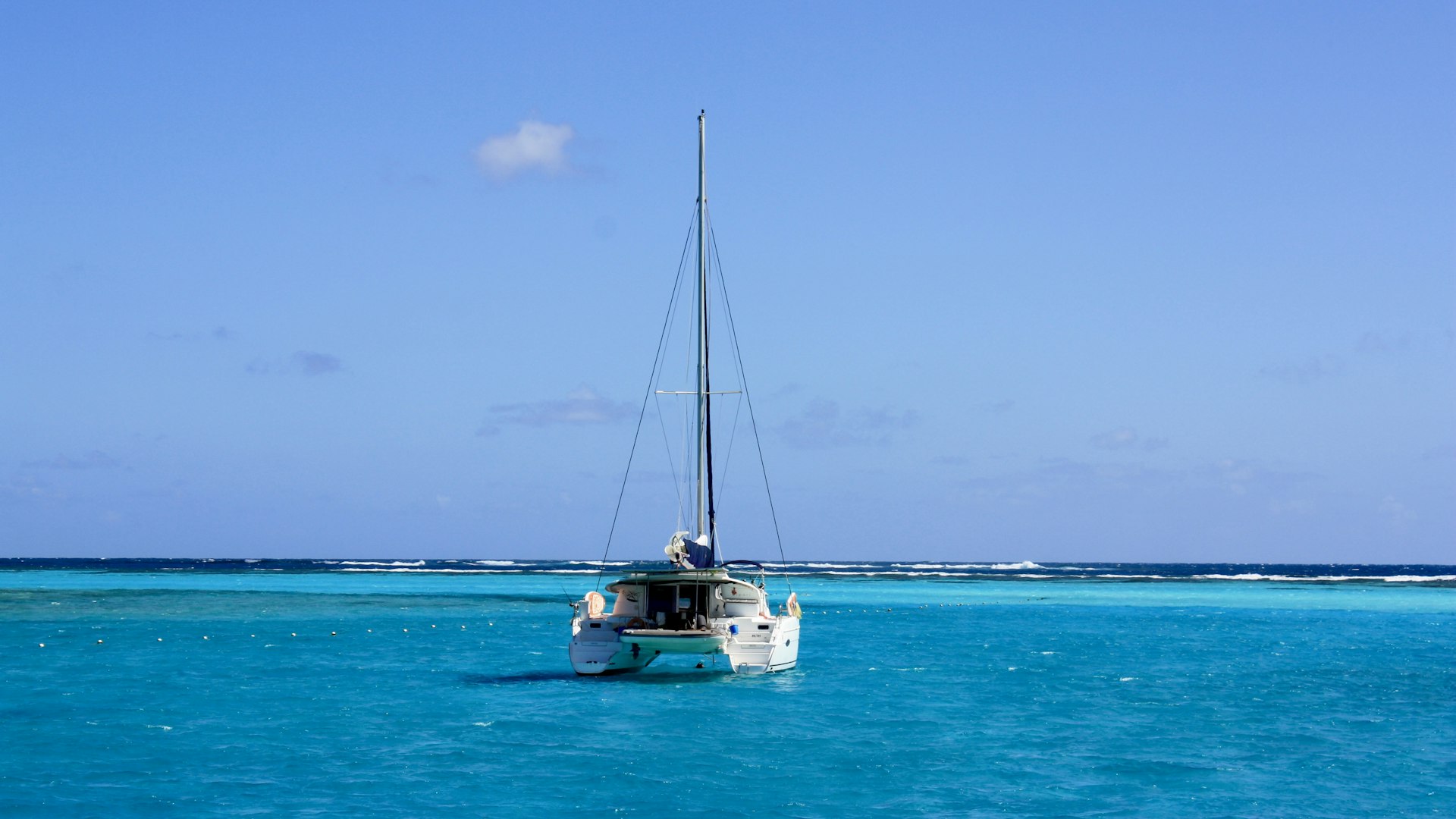
Catamaran Charter Greece
Greece rewards catamaran charterers more generously than almost any other Mediterranean destination — shallow-draft access to hidden coves, reliable summer Meltemi winds, and an archipelago of over 6,000 islands that no single charter could exhaust.
Catamarans Available in Greece
Browse our selection of catamarans available for charter in Greece.

Bareboat Sailing Yacht MAGIA VERA
Bavaria 40
From
€2k/week

Bareboat Sailing Yacht HONG KONG
Bavaria 40
From
€2k/week

Bareboat Catamaran Fountaine Pajot Lucia 40
Fountaine Pajot Lucia 40 · 2018
From
€2k/week

Bareboat Catamaran Lagoon 380
Lagoon 380 · 2015
From
€2k/week

Bareboat Catamaran Excess 11
Excess 11 · 2021
From
€3k/week

Bareboat Catamaran Lipari 41
Lipari 41 · 2012
From
€3k/week

Bareboat Catamaran Lagoon 380
Lagoon 380 · 2011
From
€3k/week

Bareboat Catamaran ALLOVI
Lagoon 400 · 2012
From
€3k/week

Bareboat Catamaran Lagoon 400 (2010)
Lagoon 400 · 2010
From
€3k/week

Bareboat Catamaran Nautitech 40 Open
Nautitech 40 Open · 2017
From
€3k/week

Bareboat Catamaran Lagoon 39
Lagoon 39 · 2014
From
€3k/week

Bareboat Sailing Yacht SWING
Lipari 41 · 2010
From
$3k/week

Bareboat Catamaran Lagoon 39 -4 + 2 Cabins
Lagoon 39 · 2016
From
€3k/week

Bareboat Catamaran CATANOO
Lagoon 39 · 2014
From
€3k/week

Bareboat Catamaran Fountaine Pajot Orana 44
Fountaine Pajot Orana 44 · 2011
From
$3k/week

Bareboat Catamaran K2
Nautitech 47 · 2009
From
€3k/week

Bareboat Catamaran Lagoon 400 S2
Lagoon 400 S2 · 2014
From
€3k/week

Bareboat Catamaran Lagoon 400 S2
Lagoon 400 S2 · 2015
From
€3k/week

Bareboat Catamaran Fountaine Pajot Isla 40
Fountaine Pajot Isla 40
From
€3k/week

Bareboat Catamaran Lagoon 380
Lagoon 380 · 2014
From
€3k/week

Bareboat Catamaran Bali Catspace
Bali Catspace · 2020
From
€4k/week

Bareboat Catamaran Excess 12
Excess 12 · 2020
From
€4k/week

Bareboat Catamaran Lagoon 400 S2
Lagoon 400 S2 · 2015
From
€4k/week

Bareboat Catamaran Lagoon 42
Lagoon 42 · 2019
From
€4k/week
Other Vessel Types in Greece
Chartering a catamaran in Greece means trading the constraints of a monohull for something closer to a floating villa. The wide beam, twin hulls, and generous deck space suit Greek sailing conditions well: Aegean afternoons demand shade and stability, and a catamaran delivers both without compromise. Whether you are threading through the Ionian's emerald channels or broad-reaching across open water towards the Dodecanese, the platform inspires confidence in guests who sail occasionally and satisfies those who sail seriously.
The Greek charter market is mature, well-regulated, and deep with choice. From a practical Lagoon 42 provisioned for a family week in the Saronic Gulf to a Sunreef 80 crewed by professionals for a month-long Cyclades expedition, the range of available catamarans covers almost any brief. What unites them is the fundamental suitability of the hull form to these waters — calm mornings for coffee on a wide foredeck, lively afternoons running downwind, and evenings swinging at anchor in a bay that has no road access at all.
Why Charter in Catamaran charter in Greece
The Greek island groups each have a distinct sailing character, and a catamaran navigates between them on its own terms. In the Ionian Sea, west of the mainland, winds are predominantly north-westerly (the Maestro) from late morning and ease predictably each evening, making passage planning straightforward even for less experienced crews. The islands — Corfu, Lefkada, Kefalonia, Ithaka, Zakynthos — lie close together, with crossings rarely exceeding 20 nautical miles. Lefkada's lagoon anchorages and Kefalonia's Fiskardo harbour represent the Ionian at its most settled and social.
The Aegean is a different proposition. The Meltemi, the dominant summer wind that builds from the north-west and can sustain Force 5 to 6 across the central Cyclades through July and August, rewards sailors who plan their routes to work with it rather than against it. A catamaran's windage can be a consideration in a stiff Meltemi, but the hull stability and deck space more than compensate. The Cyclades and Dodecanese offer genuine passage sailing between islands of real cultural weight — Delos, Santorini's caldera, the medieval city of Rhodes, the monastery-crowned heights of Patmos.
Anchorage quality in Greece is exceptional and, in many areas, still unencrowded outside the core summer weeks. Holding is generally good on sand and weed throughout the island groups. Stern-to berthing in harbour is the norm — almost every Greek fishing port has a quayside where you tie stern to the wall with your own anchor out forward, a technique that becomes second nature within a day or two. GNTO regulations require a transit log (DEKPA) for charter vessels, obtained easily on arrival, and Greek waters carry no cruising permit fee beyond that.
Catamaran charter in Greece Highlights
Fiskardo, Kefalonia — the only village on the island to survive the 1953 earthquake intact, with Venetian architecture, excellent provisioning, and reliable stern-to berths along a working harbour quay.
Koufonisia, Small Cyclades — a pair of low, sandy islands between Naxos and Amorgos with shallow lagoon anchorages perfectly suited to catamaran draft and a village taverna culture that remains genuinely local.
Delos — uninhabited and non-navigable for anchoring (regulations prohibit overnight stays), but the ancient sanctuary of Apollo reached by dinghy from a Mykonos anchorage is among the most significant archaeological sites in the Mediterranean.
Caldera anchorage, Santorini — arriving from the south by catamaran and anchoring in the volcanic caldera below Fira gives a perspective of the island that no hotel guest experiences; the swell can roll in from the west, so a settled forecast matters.
Sivota, Epirus coast — a fjord-like bay on the mainland coast opposite Lefkada, with a handful of tavernas on the water and some of the clearest anchorage holding in the Ionian.
Symi, Dodecanese — a steeply tiered neoclassical harbour town with a functioning boatbuilding tradition, day-tripper crowds that leave by 17:00, and excellent sponge-fishing heritage visible in the quayside shops.
Meganisi, Ionian — three quiet bays within a short sail of Lefkada town; Spartochori village above Port Spilia rewards the uphill walk with genuine Greek hospitality and a view across to the mainland mountains.
When to Sail
Greece has one of the most reliable sailing seasons in the Mediterranean, running from late April through October, with peak conditions and peak demand concentrated in the summer months when the Meltemi defines the Aegean experience.
High Season (Jun-Sep)
July and August bring the Meltemi at full strength in the Aegean — consistent north-westerlies that can blow Force 4 to 6 for days at a time, with gusts to Force 7 not unusual in the straits between islands. This is exhilarating sailing for competent crews and manageable on a catamaran, though itineraries must account for the wind direction rather than fight it. The Ionian is calmer and more forgiving in summer, making it the preferred choice for families or those wanting settled conditions. June and September sit either side of the Meltemi's peak and are widely regarded by experienced charterers as the sweet spot of the Greek season — warm water, full sun, and more predictable daily wind rhythms.
Shoulder Season (May, Oct)
May and October offer genuine advantages for those with flexibility. Sea temperatures remain pleasant — the Aegean holds warmth well into October — and popular anchorages that become rafted three-deep in August are largely empty. Wind patterns are less settled and occasional low-pressure systems require vigilance, but the reward is an altogether more personal experience of the islands. Provisioning is easier, harbours are quieter, and taverna prices reflect a slower pace. May in the Ionian is particularly appealing, with wild flowers on the hillsides and flat-calm mornings that make the turquoise shallows off Antipaxos genuinely remarkable.
Choosing the Right Yacht
Catamarans are, in practical terms, the optimal charter hull form for Greece. The shallow draft — typically 1.1 to 1.4 metres on most production models — opens anchorages that are inaccessible to deeper monohulls, particularly in the Cyclades' sandy-bottomed coves and the Ionian's inner lagoons. The wide beam means guests spend days and evenings on deck rather than below, which is precisely how Greek charter weeks should unfold. Models from the Lagoon range (42, 52) and Fountaine Pajot's larger hulls (the Samana 59 being well represented in the Greek fleet) offer the combination of cockpit space and privacy that groups of six to twelve guests require.
Seven Days in the Ionian from Lefkada to Kefalonia
A suggested week-long charter route
Board at Lefkada Marina in the afternoon. Lefkada is connected to the mainland by a swing bridge and has excellent provisioning close to the dock. Brief safety and systems orientation with the crew (or self-briefing for bareboat charterers), then motor south through the shallow lagoon channel to anchor off Nidri Bay for the first night.
Sail south to Meganisi, arriving at Spartochori's Port Spilia by early afternoon. Snorkel the entrance rocks, walk up to the village for lunch, and take a late mooring or anchor off the bay. The holding on sand and weed here is reliable.
A 25-nautical-mile passage south-east to Ithaka — Homer's island is mountainous and the sailing past its western cliffs is among the more dramatic in the Ionian. Anchor in Kioni Bay, a small harbour with three working windmills above and good taverna options on the quay.
Short morning passage (12 nautical miles) across to Fiskardo on Kefalonia's northern tip. Secure a stern-to berth on the town quay by mid-morning before the flotillas arrive. Afternoon for exploring the Venetian lighthouse ruins and the fish market. Dinner at one of the harbour-front restaurants.
Day at anchor off Antisamos Bay, Kefalonia's east coast — a pebble bay surrounded by green hills with very clear water and good swimming. This location was used in the filming of Captain Corelli's Mandolin. Return to Fiskardo for the night or push south to anchor off Argostoli Bay.
Sail north via Kalamos and Kastos, two small islands east of Lefkada with secluded anchorages and almost no tourist infrastructure. Anchor off Kastos village for lunch, then continue to Sivota on the Epirus coast for the evening — a deeply sheltered inlet with several tavernas and reliable mooring buoys.
Return passage to Lefkada Marina — 12 nautical miles, typically a morning beat or reach depending on the day's Maestro. Arrive in time for handover formalities. Final lunch ashore before evening flights from Preveza (Aktion) Airport, 20 minutes from the marina.
Local Tips
- •The DEKPA transit log is required for all charter vessels in Greek waters and is issued by the Port Authority (Limenarchio) at your base marina on embarkation day. Carry it at all times; harbour police in smaller ports check it routinely and the process is simple if your papers are in order.
- •Provision thoroughly at your home marina before departure. Lefkada, Athens (for Saronic Gulf charters), and Kos all have supermarkets within reasonable distance of the dock. Fresh fish is reliably available in harbours throughout the islands, but fresh meat, good cheese, and specialist provisions are harder to source mid-trip.
- •In the Aegean, plan passages for early morning. The Meltemi typically builds through the late morning and is at its strongest between 14:00 and 18:00. Departing at 07:00 allows you to reach your next anchorage before conditions become lively, and you will secure the best anchorage position before the afternoon arrivals.
- •Octopus drying on a line outside a harbourside taverna is a reliable indicator of a kitchen worth eating in — it means the owner is curing their own. Greek cuisine in charter areas has improved measurably in the last decade; the better tavernas now serve local dishes with genuine regional identity rather than generic tourist menus.
- •Catamaran beam awareness is important in small Ionian fishing harbours. Many traditional quaysides were built for caïques and are poorly fender-matched to a 7.5-metre-wide hull. Approach slowly, have crew on both hulls with fenders, and use your own anchors fore-and-aft where the bottom is too soft for a single bower to hold cleanly.
- •Water consumption matters on longer passages away from large marinas. Greek island water quality varies, and many anchorages have no shore facilities at all. Stock water generously at provisioning stops and monitor tank levels; desalination capacity on larger charter catamarans helps significantly mid-week.
Frequently Asked Questions
Do I need a sailing licence to charter a catamaran bareboat in Greece+
Which Greek island group is best suited for a first catamaran charter+
What is the Meltemi and how does it affect catamaran charter planning+
Are crewed catamarans available in Greece and what does a crew typically include+
What is the typical charter week duration and can I book shorter periods+
How far in advance should I book a catamaran charter in Greece for July or August+
Speak to a SelectYachts specialist to match the right catamaran to your Greek itinerary, group size, and budget.
Request Your Charter