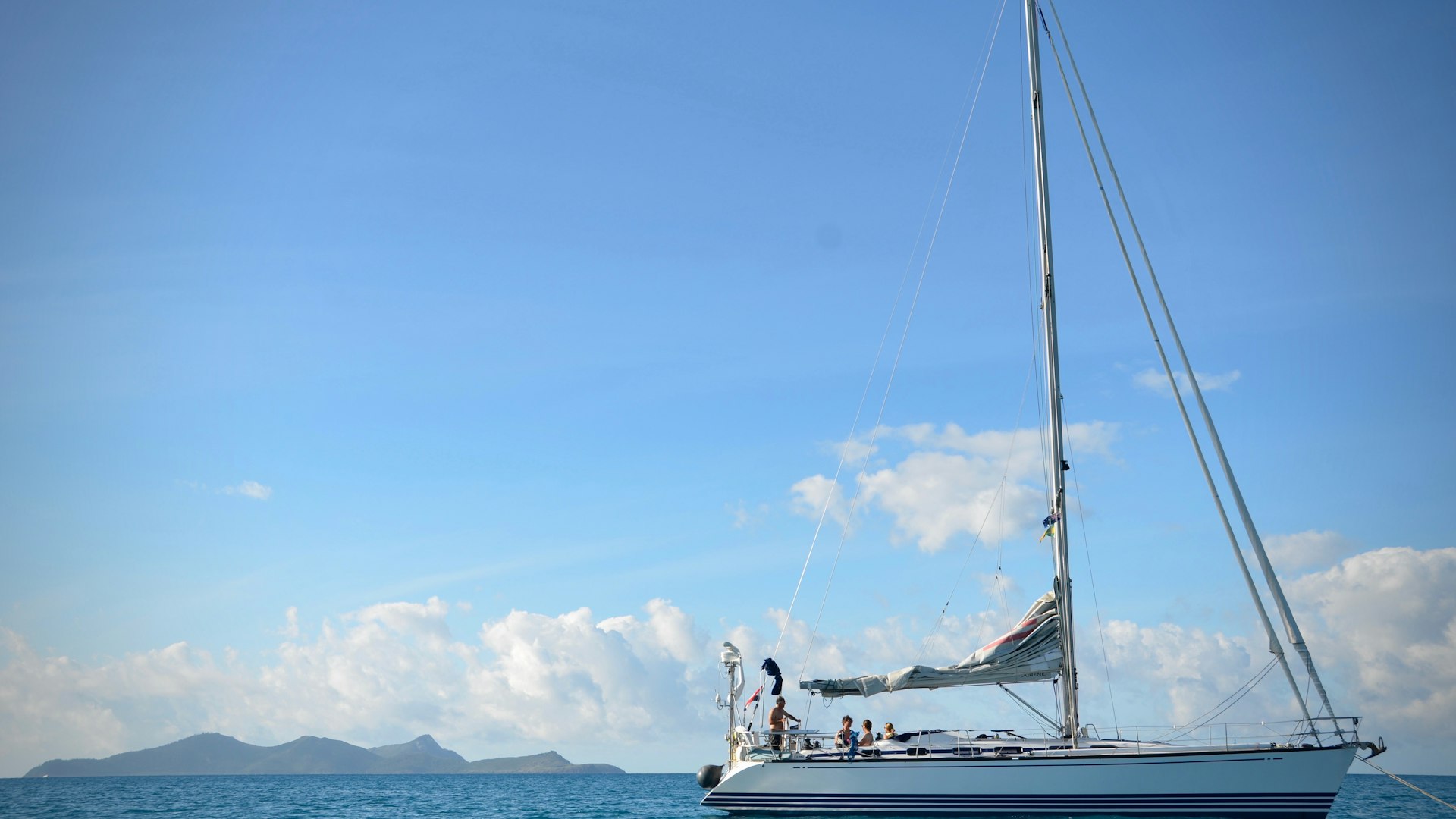
Australia Yacht Charters
From the Whitsunday Passage to the Kimberley coast, Australia offers some of the most varied and genuinely remote blue-water cruising in the southern hemisphere, with predictable trade winds, world-class anchorages, and a marine environment that rewards the well-prepared charterer.
Charter by Vessel Type
Catamaran Charter in Australia
Spacious twin-hull vessels offering stability, comfort, and generous deck space for the ultimate charter experience.
Browse Catamarans →
Sailing Yacht Charter in Australia
Classic sailing vessels that combine timeless elegance with the thrill of wind-powered adventure.
Browse Sailing Yachts →
Motor Yacht Charter in Australia
Powerful luxury vessels delivering speed, sophistication, and effortless cruising across any waters.
Browse Motor Yachts →
Available Yachts in Australia

Bareboat Sailing Yacht ENCORE
Sun Odyssey 49
From
$37/week

Bareboat Sailing Yacht Dufour 412
Dufour 412 · 2018
From
€4k/week

Bareboat Catamaran Nautitech 40 Open
Nautitech 40 Open
From
$7k/week

Bareboat Catamaran Bali 4.3
Bali 4.3 · 2017
From
€7k/week

Bareboat Catamaran Lagoon 40
Lagoon 40
From
$9k/week

Bareboat Catamaran Bali 4.2
Bali 4.2
From
$9k/week

Bareboat Catamaran Fountaine Pajot Elba 45
Fountaine Pajot Elba 45
From
$13k/week

Luxury Crewed Catamaran BABAC
Lagoon Seventy7 · 2018
From
$60k/week

Luxury Crewed Motor Yacht LUMIR
Heesen 3700 · 2005
From
$140k/week

Luxury Crewed Motor Yacht INTRIGUE
Jade Yacht 28m · 2010
Price on request
View →
Luxury Crewed Motor Yacht AURA
Horizon 90 · 2023
Price on request
View →
Luxury Crewed Motor Yacht LITTLE PERLE
Moonen 30m Superyacht · 2008
Price on request
View →Australia's coastline stretches over 35,000 kilometres, yet the country's charter market remains refreshingly uncrowded compared with the Mediterranean or Caribbean. That contrast is precisely the point. Whether you are threading through the 74 islands of the Whitsundays under the South-East Trades, exploring the ancient tidal inlets of the Kimberley aboard a capable expedition vessel, or anchoring off a deserted stretch of the Coral Sea, the sheer scale and diversity of the sailing ground is unlike anywhere else in the world.
Australia demands a degree of self-sufficiency that many experienced charterers find bracing after years in charter-dense waters. Fuel ranges, provisioning windows, and tidal calculations matter here in ways they simply do not on the Côte d'Azur. That additional layer of preparation, however, is precisely what makes an Australian charter so satisfying to execute well.
Why Charter in Australia
The Whitsundays sit at the heart of the Great Barrier Reef Marine Park, and they remain the most accessible and logistically comfortable entry point for first-time Australian charterers. The South-East Trade wind blows reliably between 15 and 25 knots from May through October, the water clarity around Bait Reef and the outer Reef can exceed 20 metres, and the anchorage at Whitehaven Beach on Whitsunday Island is among the finest in the Pacific. Airlie Beach serves as the main provisioning hub, with a marina infrastructure capable of handling anything from a Bali 4.2 catamaran to a large motor yacht.
Beyond Queensland, the Kimberley region of Western Australia represents a genuinely frontier experience. The Montgomery Reef, the horizontal waterfalls at Talbot Bay, and the extraordinary tidal ranges of up to 12 metres along the Buccaneer Archipelago are accessible only by sea, and almost exclusively to privately chartered vessels. This is expedition cruising in the truest sense: a Heesen or Horizon motor yacht with an experienced local skipper and a well-stocked tender is the appropriate platform.
Sydney Harbour itself warrants mention as a charter destination in its own right. Racing on Port Jackson during the winter season, dining at waterfront restaurants accessible only by tender, and arriving at the Cruising Yacht Club of Australia after a coastal passage from the Hunter Valley give the New South Wales coast a sophisticated, urbane character entirely distinct from tropical Queensland.
Australia Highlights
Whitehaven Beach, Whitsunday Island - Seven kilometres of silica sand accessible only by boat, with Hill Inlet's tidal swirl of white sand and turquoise water offering one of the most photographed perspectives in Australian sailing.
Bait Reef and the Stepping Stones - An outer Great Barrier Reef dive site 60 nautical miles east of Airlie Beach, offering wall diving, pelagic encounters, and a mooring field that empties out by late afternoon.
Nara Inlet, Hook Island - A narrow, sheltered fjord with Aboriginal rock art and absolute calm anchorage even in a stiff South-Easter; the kind of place you anchor for two nights without meaning to.
Montgomery Reef, Kimberley - At low tide, an entire reef system emerges from the sea and water cascades off the edges in what appear to be miniature waterfalls; access is via tender and requires local tidal knowledge.
Sydney Harbour - Anchoring off Shark Island or Quarantine Bay, with the Bridge and Opera House framing a sundowner that no purpose-built marina berth can replicate.
Lizard Island - The northernmost island resort on the Great Barrier Reef, with Cod Hole on the outer reef less than 30 nautical miles away and Watson's Bay offering reliable all-weather anchorage.
Ribbon Reefs, Coral Sea - A chain of ten outer reef formations running north from Cape Flattery, offering outstanding drift diving and the rare experience of sailing in waters where commercial traffic is virtually absent.
When to Sail
Australia's vast geography means there is no single sailing season; the Whitsundays and Queensland coast are at their best between May and October, while the Kimberley window is tightly compressed into the same dry-season months, and New South Wales and Victoria sail well year-round with seasonal adjustments.
High Season (Jun-Sep)
This is the dry season across northern and central Queensland, with the South-East Trades at their most consistent and the threat of tropical cyclones effectively zero. Water temperatures in the Whitsundays hover around 22-24°C, visibility on the outer Reef is exceptional, and anchorages are comfortable. The Kimberley is at its peak in these months, with low humidity and calm mornings ideal for navigating the tidal channels. Boats book early for this window; lead times of six to twelve months are not unusual for preferred vessels and itineraries.
Shoulder Season (May, Oct)
May and October offer quieter anchorages and competitive availability with conditions that remain very good across the Whitsundays. The Trades are either building or beginning to ease, and sea temperatures are pleasant in both months. October in particular can extend into an excellent sailing period before the wet season and cyclone risk begins to increase through November and December. Southern Australia, including Sydney and the Mornington Peninsula, tends to be mild and often sparkling in October, making it a strong alternative for those who prefer temperate sailing.
Choosing the Right Yacht
For the Whitsundays, catamarans are the dominant and most practical choice. The shallow draught of vessels such as a Fountaine Pajot or a Bali 4.2 allows access to anchorages that deeper-keeled monohulls cannot comfortably reach, and the deck space and stability at anchor suit the snorkelling, diving, and beach-going rhythms that define a Queensland charter. The reliable Trade wind also makes a sailing catamaran genuinely efficient over the relatively short inter-island passages of 5 to 25 nautical miles that characterise the region. A Lagoon Seventy7 or similar large performance cat handles the occasional 30-knot squall without drama and provides the interior volume that longer charters require.
Seven Days Through the Whitsundays and Southern Great Barrier Reef
A suggested week-long charter route
Depart Airlie Beach (Abel Point Marina) in the early morning on the flood tide, heading north-east toward Cid Harbour on Whitsunday Island. Settle into the anchorage, launch the tender, and explore the bush tracks above the bay in the afternoon. Dinner aboard as the charter settles into its rhythm.
A short 8-nautical-mile passage to Whitehaven Beach. Arrive early to secure a swinging anchorage before the day-tripper influx. Walk the beach at low tide when the silica sand is at its firmest, then take the tender up to Hill Inlet for the elevated view over the sandbars. Anchor overnight; very few day-tripper vessels remain after 1600.
Sail north through the Whitsunday Passage, passing between Hayman and Hook Islands before turning into Nara Inlet on Hook Island's south-eastern shore. This narrow fjord requires attention to the entrance depth at low water but rewards with flat-calm conditions regardless of what the Trades are doing outside. Visit the Aboriginal rock art site at the head of the inlet on foot.
A longer offshore passage of approximately 50 nautical miles to Bait Reef, departing with the morning breeze. Secure a mooring buoy at the Stepping Stones and spend the afternoon diving or snorkelling the outer reef wall. This is genuinely open-water territory; the passage back to the islands offers excellent sailing in 18 to 22 knots if you choose not to overnight at the mooring.
Return west and anchor off Langford Reef near Hayman Island, a low-tide sandspit with a lagoon that makes an exceptional lunch stop. Afternoon at leisure before moving to a protected anchorage on the north side of Hook Island for the night.
Explore the Blue Pearl Bay snorkel trail on Hayman's south-west shore in the morning, then sail south through the Passage to Thomas Island or Shaw Island on the southern fringe of the group, areas that see a fraction of the traffic of the northern anchorages. A relaxed final evening at anchor.
Return to Abel Point Marina by late morning, allowing time for disembarkation, luggage transfer, and an unhurried lunch at one of the Airlie Beach waterfront restaurants before onward travel. The marina's fuel dock and provisioning services make the turnaround efficient if crew are collecting the next charter party.
Local Tips
- •Australian Border Force and DAFF biosecurity requirements are stringent and non-negotiable for any vessel arriving from international waters. Ensure all crew and guest passports are current, declare all food and biological material honestly, and brief guests before arrival. Fines for undeclared items are significant and the process cannot be hurried.
- •Provisioning in Airlie Beach is comprehensive for a regional town, but specialty items, premium wines, and specific spirits are better sourced from Brisbane or Townsville before departure. If your charter includes significant offshore passages, factor in additional fuel loads and carry more fresh water capacity than you think you need.
- •The Great Barrier Reef Marine Park Authority issues strict regulations on anchoring within the Marine Park; designated moorings must be used in many high-use areas, and the mooring buoys at Bait Reef and other outer reef sites must be booked in advance during peak season. Your charter broker or skipper should handle this, but confirm it explicitly.
- •Tipping culture in Australia is less formalised than in the United States or Caribbean. For professional crew doing an excellent job, 10 to 15 per cent of the charter fee is a generous and well-received gesture, but it is not an expected baseline. Most crew will be surprised and genuinely appreciative rather than calculating.
- •For the Kimberley in particular, local skipper knowledge is not optional. The tidal ranges, unmarked hazards, and remoteness of the region mean that even highly experienced offshore sailors hire a qualified local guide or operate with a skipper who has documented Kimberley experience. This is not an area for autonomous first-time exploration.
- •Mobile and data connectivity is excellent in Sydney Harbour and along the NSW coast but drops significantly north of Townsville and is effectively absent in the Kimberley. Satellite communications should be considered standard equipment for any remote Australian charter, and guests should be briefed accordingly before departure.
Frequently Asked Questions
Do I need a sailing licence to charter a yacht in Australia+
What is the best base for a Whitsundays charter+
Is the Great Barrier Reef safe to sail in terms of navigation+
Can I sail from the Whitsundays to Cairns in a single charter+
What size group can an Australian charter accommodate+
How far in advance should I book an Australian charter+
Speak with the SelectYachts team to discuss the right vessel, routing, and season for your Australian charter.
Request Your Charter