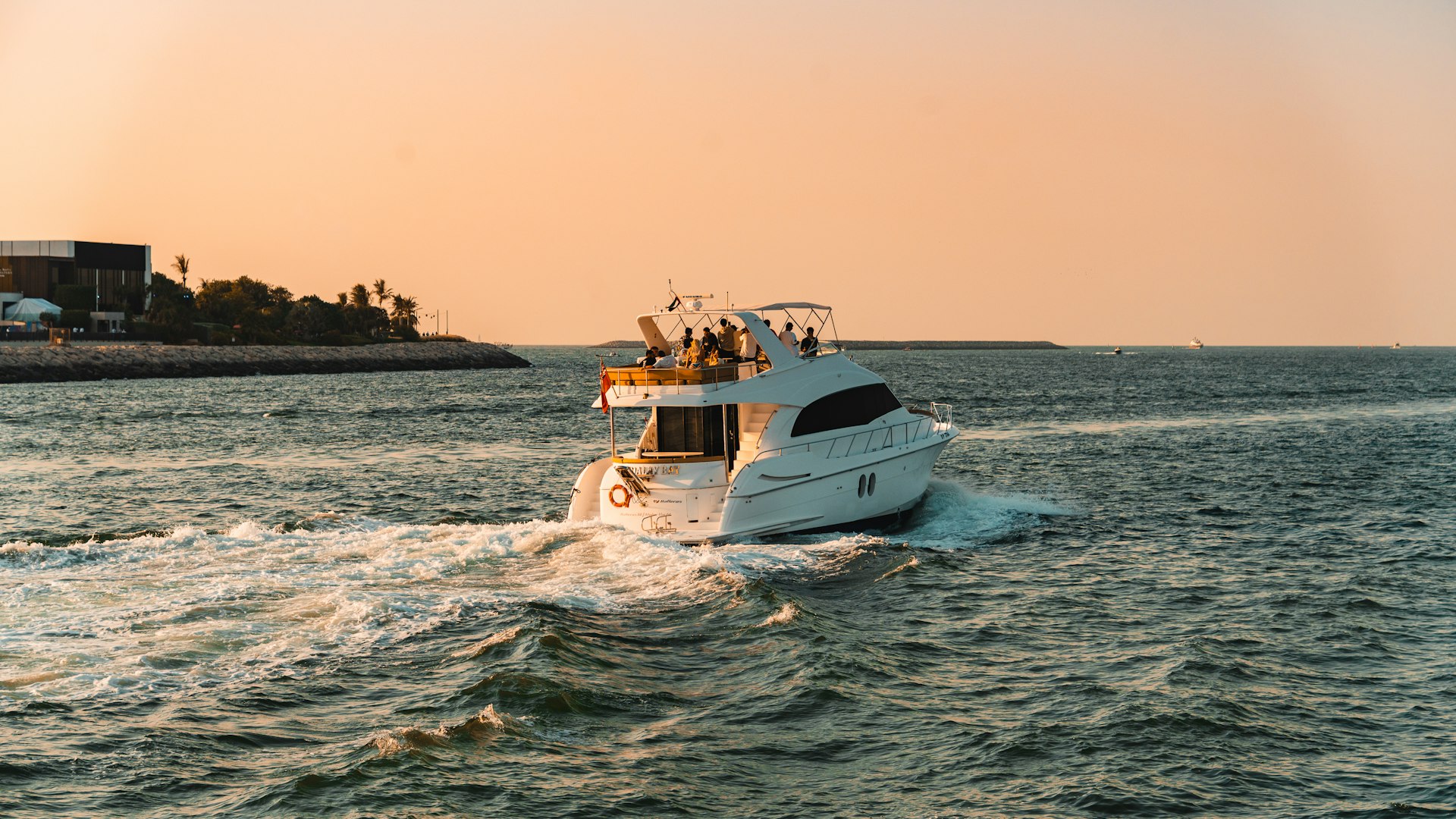
Motor Yacht Charter Greece

Motor Yacht Charter Greece

Greece rewards motor yacht charterers with a 16,000-kilometre coastline, predictable summer winds, and an archipelago geography that turns each morning's passage into a considered decision rather than a forced march.

Motor Yachts Available in Greece

Browse our selection of motor yachts available for charter in Greece.

Crewed Motor Yacht Fjord 40 Open
motor yacht

Crewed Motor Yacht Fjord 40 Open

Fjord Open 40 · 2007

12.8m 9 1

From

€2k/week

View →
Crewed Motor Yacht Vanquish 43 Open
motor yacht

Crewed Motor Yacht Vanquish 43 Open

Vanquish 43 Open · 2017

13.0m 8

From

€3k/week

View →
Crewed Motor Yacht Ferretti 53
motor yacht

Crewed Motor Yacht Ferretti 53

Ferretti 53 · 2017

16.8m 10 3

From

€3k/week

View →
Crewed Motor Yacht Sunseeker Portofino 53
motor yacht

Crewed Motor Yacht Sunseeker Portofino 53

Sunseeker Portofino 53 · 2004

16.0m 10 2

From

€3k/week

View →
Crewed Motor Yacht Ferretti 550 Flybridge
motor yacht

Crewed Motor Yacht Ferretti 550 Flybridge

Ferretti 550 Flybridge · 2005

17.4m 10 3

From

€3k/week

View →
Crewed Motor Yacht Ferretti 590
motor yacht

Crewed Motor Yacht Ferretti 590

Ferretti 590

18.3m 12 3

From

€3k/week

View →
Crewed Motor Yacht Ferretti 68
motor yacht

Crewed Motor Yacht Ferretti 68

Ferretti 68 · 2005

21.2m 12 3

From

€4k/week

View →
Crewed Motor Yacht Pershing 65
motor yacht

Crewed Motor Yacht Pershing 65

Pershing 65 · 2003

20.3m 10 3

From

€4k/week

View →
Crewed Motor Yacht Ferretti 760
motor yacht

Crewed Motor Yacht Ferretti 760

Ferretti 760 · 2016

23.4m 12 4

From

€6k/week

View →
Crewed Motor Yacht Pershing 72
motor yacht

Crewed Motor Yacht Pershing 72

Pershing 72 · 2008

22.3m 10 3

From

€8k/week

View →
Crewed Motor Yacht CARINA
motor yacht

Crewed Motor Yacht CARINA

Princess 15m · 2005

15.0m 2

From

€12k/week

View →
Crewed Motor Yacht EL NIMA
motor yacht

Crewed Motor Yacht EL NIMA

Portofino 47 · 2012

14.0m 1

From

€13k/week

View →
Crewed Motor Yacht LAKOUPETI
motor yacht

Crewed Motor Yacht LAKOUPETI

Pershing 54 · 2002

16.4m 2

From

€13k/week

View →
Crewed Motor Yacht BIG BALLOON
motor yacht

Crewed Motor Yacht BIG BALLOON

Seanfinity T5 · 2023

14.0m 4 2

From

€14k/week

View →
Luxury Crewed Motor Yacht CATHERINES
motor yacht

Luxury Crewed Motor Yacht CATHERINES

Ferretti 38 · 1993

17.7m 3

From

€14k/week

View →
Crewed Motor Yacht PALMYRA
motor yacht

Crewed Motor Yacht PALMYRA

Ferretti 57 · 1999

17.8m 3

From

€14k/week

View →
Crewed Motor Yacht PRAXIS 4
motor yacht

Crewed Motor Yacht PRAXIS 4

Aicon 63 · 2011

19.0m 6 3

From

€15k/week

View →
Crewed Motor Yacht EVENIA
motor yacht

Crewed Motor Yacht EVENIA

Princess 65 · 2004

20.0m 6 3

From

€16k/week

View →
Luxury Crewed Motor Yacht GEORGE V
motor yacht

Luxury Crewed Motor Yacht GEORGE V

Aicon 64 · 2008

20.0m 8 4

From

€16k/week

View →
Luxury Crewed Motor Yacht LETTOULI III
motor yacht

Luxury Crewed Motor Yacht LETTOULI III

Posilippo 21m · 2007

21.0m 4

From

€17k/week

View →
Crewed Motor Yacht SUMMER THERAPY
motor yacht

Crewed Motor Yacht SUMMER THERAPY

Aicon 67 · 2005

20.0m 8 4

From

€17k/week

View →
Crewed Motor Yacht LAVIN
motor yacht

Crewed Motor Yacht LAVIN

Custom 26m · 2024

26.5m 8 4

From

€17k/week

View →
Crewed Motor Yacht MEDUSA
motor yacht

Crewed Motor Yacht MEDUSA

Azimut 68 · 2005

21.0m 8 4

From

€18k/week

View →
Luxury Crewed Motor Yacht BELIZ
motor yacht

Luxury Crewed Motor Yacht BELIZ

Maiora 23m · 1998

23.0m 8 4

From

€18k/week

View →

Few cruising grounds match Greece for sheer variety compressed into short distances. From the marble-pale cliffs of the Cyclades to the forested coves of the Ionian, from the volcanic caldera of Santorini to the Ottoman-inflected waterfront of Kos, a single two-week charter can move through half a dozen distinct cultural and geological worlds. A motor yacht accelerates that freedom: you are not waiting for the Meltemi to abate before crossing to the next island, and you are not anchoring a mile offshore because your draught rules out the best bay.

Greece has matured considerably as a charter destination. Athens, Mykonos, and Corfu now offer marina infrastructure, provisioning, and crew services comparable to the Côte d'Azur, while dozens of quieter anchorages remain entirely uncommercialised. The country's ENFIA cruising tax regime and the requirement to hold a Transit Log (DEKPA) add minor administrative layers, but a competent broker handles these as routine. What remains is one of the world's most legible sailing geographies: a clear blue sea, an identifiable wind regime, and a cuisine built on short supply chains.

Why Charter in Motor Yacht charter in Greece

Greece's island geography is uniquely suited to motor yachts. The Aegean in particular presents passages of 15 to 40 nautical miles between significant islands, distances that a planing or semi-displacement vessel covers before lunch. This lets charterers use mornings for transit and afternoons for exploration ashore, rather than spending the majority of daylight hours underway. The Ionian islands are closer together still, making them ideal for slower, more social itineraries where the emphasis is on anchoring off deserted beaches rather than covering ground.

The Meltemi, the dominant summer wind of the Aegean, blows from the north-northwest between June and August, frequently reaching Force 5 to 6 in exposed passages around Mykonos, Paros, and the eastern Cyclades. For sailing yachts this is sometimes a constraint; for a well-powered motor yacht it is largely irrelevant. You retain the ability to depart on your own schedule, reach anchorages that lie upwind of the prevailing breeze, and cross exposed stretches like the Cycladic plateau or the northern Aegean regardless of wind direction. This operational flexibility is a genuine advantage in a destination where weather windows can close quickly in late summer.

Beyond the sailing mechanics, Greece remains one of the most intact food cultures in the Mediterranean. A market morning in Heraklion, a grilled lavraki on the quay in Nafplio, or a cephalopod meze at a waterside taverna in Galaxidi are experiences that reward those who look beyond resort-facing tourist menus. Motor yacht charters in Greece frequently integrate private chef provisioning with local market runs, allowing the galley to respond to what the fishing boats brought in that morning rather than a pre-ordered list.

Motor Yacht charter in Greece Highlights

1

Spetses and the Saronic Gulf: Accessible from Athens Marina (Zea or Flisvos), the Saronic provides a genuine cruising circuit within two hours of the city. Spetses retains car restrictions on most of the island, making it quieter than its popularity suggests. The anchorage off Agios Anargyroi is one of the better-protected bays in the gulf.

2

Navagio Beach, Zakynthos: The shipwreck cove is impossible to reach by land and rewards those who anchor off early morning before the tourist boats arrive from Porto Vromi. The limestone cliffs provide dramatic shelter and the water clarity is exceptional even by Greek standards.

3

The Cyclades Circuit (Syros, Paros, Naxos, Amorgos): Syros's neoclassical capital Ermoupoli is a working port city rather than a tourist stage set, and its market is among the best provisioned in the islands. Naxos produces its own cheese, wine, and potatoes of genuine quality. Amorgos, at the circuit's eastern edge, remains largely uncommercialised.

4

Hydra: No motorised vehicles on the island, a well-protected port, and a social scene that has attracted artists and writers since the 1960s without becoming a parody of itself. Berthing on the town quay requires booking ahead in July and August but rewards the effort.

5

Lefkada Canal and Meganisi: The Lefkada Canal is a sheltered inland waterway connecting the island to the mainland. Meganisi, just south, offers deep turquoise inlets including Atherinos Bay and Vathi harbour, where the tavernas are run by families who have been there for generations.

6

Crete's South Coast: The northern coast of Crete is more developed and more exposed. The south coast, accessible via the western tip at Gramvousa or through the Kissamos Strait, presents a largely untouched shoreline with small harbours at Paleochora, Loutro (reachable only by boat or foot), and Agia Roumeli at the mouth of the Samaria Gorge.

7

The Dodecanese: Rhodes to Patmos: Rhodes' commercial port handles superyachts routinely, and the old town warrants a proper afternoon on foot. Moving north, Symi's neoclassical harbour at Gialos is architecturally arresting. Patmos, at the chain's northern end, carries a different gravity: the Monastery of Saint John has commanded the hilltop above Skala since the eleventh century.

When to Sail

Greece's primary charter season runs from late April through October, with peak demand concentrated in July and August. Shoulder months offer gentler conditions, lower charter costs in many cases, and considerably quieter anchorages.

High Season (Jun-Sep)

June offers settled weather and sea temperatures above 22°C before the Meltemi establishes itself fully. July and August are the busiest months: marinas at Mykonos, Ios, and Santorini fill early, and popular anchorages like Delos or the Blue Caves at Zakynthos require early morning arrivals to secure space. The Meltemi blows most persistently through August, with northern and central Aegean passages occasionally rough. September is widely regarded as the optimal month: winds ease, sea temperatures remain high, and the crowds thin noticeably after the first week.

Shoulder Season (May, Oct)

May is excellent for the Ionian, where the weather is already warm and the charter traffic is a fraction of the summer peak. Water temperatures lag slightly, but air temperatures in the southern Aegean are comfortable from mid-month. October brings autumn light and calm seas across most of the Aegean, with the Meltemi spent. Some smaller tavernas and beach clubs close from the first week of October onwards, and provisioning in remote areas requires more planning, but the sailing quality is high and the coastline reverts to something closer to its working character.

Choosing the Right Yacht

Greece suits a wider range of motor yachts than almost any other Mediterranean destination. The compact scale of the Saronic and Ionian islands, with harbour depths often limited to 3 to 4 metres alongside, makes semi-displacement cruisers in the 20 to 35-metre range particularly practical: they offer genuine seakeeping for open Aegean passages while still fitting comfortably into smaller harbours. Models such as the Princess 85 represent this category well, combining capable range with proportionate beam for Med-style stern-to berthing. For larger groups or those prioritising volume and stabilisation, full-displacement superyachts in the 40 to 60-metre bracket, including examples from Benetti and Codecasa, perform predictably in the moderate sea states of the Ionian and are increasingly well served by Athens and Corfu's superyacht facilities.

Seven Days in the Saronic and Argolic Gulf from Athens

A suggested week-long charter route

Day 1

Depart Flisvos Marina, Athens, heading southwest across the Saronic Gulf. The crossing to Aegina takes approximately 90 minutes at moderate speed. Berth in Aegina Town or anchor in the bay below the Temple of Aphaia for a late afternoon swim. Dinner aboard or ashore at one of the harbour-facing restaurants known for fresh grilled fish and the island's prized pistachios.

Day 2

Morning passage south past the low-lying islet of Moni, which shelters a small nature reserve with resident peacocks and deer, before continuing to Hydra. Secure a berth on the town quay or anchor in Mandraki cove to the east. The absence of motor vehicles makes Hydra an unusually calm evening port. Provisions can be sourced from the port-side market for the ship's galley.

Day 3

Round the eastern tip of the Argolid Peninsula and enter the Gulf of Argolis, one of the most historically dense bodies of water in Greece. Anchor off Spetses in the morning and take the tender into the old harbour at Dapia. Continue north into the gulf in the afternoon, anchoring for the night in the bay below ancient Tiryns or proceeding directly to Nafplio, the first capital of modern Greece, where the Venetian fortifications are visible from the anchorage.

Day 4

A full day in and around Nafplio. The Palamidi fortress above the town requires effort to reach but offers a clear view of the entire gulf. The old town streets are tight, neoclassical, and largely car-free in their pedestrianised core. The market near the bus station is a serious provisioning stop, particularly for local cheeses, cured meats, and Nemea wine from the Peloponnese interior. Overnight at anchor in the gulf or alongside in the town marina.

Day 5

Depart Nafplio and head south to Leonidio, a small harbour backed by extraordinary red cliffs rising from the coastal plain. The town is known for its Tsakonian dialect, one of the oldest surviving Greek dialects, and for aubergines of an unusual elongated variety that appear in local dishes. The anchorage is open to the south but settled in summer. Continue in the afternoon if conditions allow to the more protected bay at Kiparissi.

Day 6

The return leg offers options. A direct passage north back through the Saronic is straightforward in calm or northerly conditions; alternatively, a detour to Poros allows a final night in the narrow channel between the island and the Peloponnese mainland, where the town reflects in the water from both sides simultaneously and the daily ferry traffic creates a lively early evening atmosphere on the waterfront.

Day 7

Morning passage back to Athens via the southern approaches to the Saronic. The return to Flisvos or Zea Marina can be timed to avoid the midday heat and the late afternoon ferry traffic crossing from Piraeus. Handover formalities in Athens are straightforward for experienced charter operations, and the proximity to the international airport at Eleftherios Venizelos makes Athens an efficient end point for guests flying home.

Local Tips

  • The Transit Log (DEKPA) is mandatory for all charter vessels operating in Greek waters. Your broker will arrange this prior to departure, but ensure the paperwork is aboard before you leave the home port. Port authority checks occur routinely in popular harbours and the documentation requirements are applied consistently.
  • Fuel availability varies significantly between island groups. The Ionian and Saronic have adequate bunkering options in main harbours. In the eastern Aegean and along the Dodecanese, plan fuel stops carefully and maintain larger reserves than you might in French or Italian waters. Kalymnos, Kos, and Rhodes town all have reliable marine fuel.
  • Provisioning is best done in larger hubs: Athens (Flisvos), Corfu Town, Rhodes, and Heraklion have the range of suppliers to stock a large motor yacht properly. In smaller islands, tavernas frequently sell direct from producers and it is worth having the chef come ashore to negotiate rather than ordering remotely.
  • Marina reservations in July and August in Mykonos, Santorini (Athinios and the new Vlychada marina), and Hydra require booking weeks in advance. For anchorages, position determines everything: arrive before noon in any well-known bay. Early morning departures from the previous port are standard practice for experienced crews on this circuit.
  • Customs and VAT considerations: Yachts over 7 metres flagged outside the EU may charter in Greek waters under Temporary Admission provisions, but the rules have tightened in recent years and HMRC-style declarations are taken seriously by Greek port authorities. Confirm your vessel's tax status with your broker well before departure.
  • Tipping culture in Greek marinas involves a modest acknowledgement for the marineros who assist with lines and water connections, typically in cash. In harbours without official marineros, locals who assist informally expect similar recognition. Crew-to-crew relations are generally collegial and communication in English is reliable in all primary charter ports.

Frequently Asked Questions

Do I need a cruising permit to charter a motor yacht in Greece+
Yes. All charter vessels operating in Greek waters require a Transit Log (DEKPA), issued by the Greek authorities and arranged by your broker or charter manager prior to embarkation. Additionally, yachts over a certain length may be subject to port fees levied by local harbour authorities, which vary by municipality. Non-EU flagged vessels have separate temporary admission requirements that your broker should clarify based on the specific vessel you charter.
Which Greek island group is best for a first motor yacht charter+
The Saronic Gulf is the most accessible starting point: short passages, good infrastructure, and Athens as a convenient arrival and departure hub. The Ionian islands (Corfu, Lefkada, Kefalonia, Zakynthos) offer calmer seas than the Aegean and are well suited to those prioritising anchoring in sheltered bays over covering significant distances. The Cyclades reward more experienced charterers or those working with a professional captain who knows the Meltemi patterns well.
How do motor yachts perform in the Meltemi+
The Meltemi is a thermal wind that funnels through the Aegean from the northwest, typically Force 4 to 6 with gusts higher in exposed channels. A well-powered motor yacht handles these conditions comfortably and can choose departure times and routings that minimise exposure. The primary inconvenience is sea state rather than wind itself: short, steep Aegean chop can be uncomfortable in smaller or lighter-displacement vessels. Semi-displacement and displacement hulls above 25 metres tend to manage the conditions well. Your captain will advise on passage timing.
What is the typical weekly cost of chartering a motor yacht in Greece+
Charter fees span an exceptionally wide range depending on vessel size, specification, and season. At the market median, a well-equipped motor yacht suitable for a group of eight to ten guests runs broadly in the region of EUR 60,000 to 70,000 per week before expenses. Expenses (fuel, provisioning, marina fees, crew gratuity) typically add 25 to 40 per cent on top of the base rate, with fuel being the dominant variable for faster motor yachts. Larger expedition-style or superyacht-category vessels command significantly higher fees.
What size group can a motor yacht charter accommodate in Greece+
Our Greece motor yacht fleet spans from intimate vessels suited to couples or small families up to large superyachts accommodating guest groups of 20 or more for day use or extended charters. For overnight accommodation, most charter yachts sleep between 6 and 12 guests comfortably. Some vessels are available for corporate or event charters with larger day-guest capacities. If group size is a primary consideration, filter by guest capacity from the outset rather than adding guests to a vessel selected on other criteria.
Is Greece a good destination for a charter with children+
Greece is generally well suited to families. The Ionian islands in particular offer calm anchorages, shallow sandy approaches accessible by tender, and a warm, shallow sea that reaches comfortable swimming temperature by late May. The Saronic Gulf is similarly manageable for young children. The Cyclades in high summer require more careful passage planning due to the Meltemi, but the destination rewards those who plan around it. Most professional crewed motor yachts can be equipped with inflatables, paddleboards, and snorkelling gear as part of the standard water toys package.

Contact our Greece specialists to match your dates, group size, and preferred island circuit with the right vessel from our verified fleet.

Request Your Charter

Request Your Charter

Tell us about your dream voyage and we will find the perfect yacht for you.