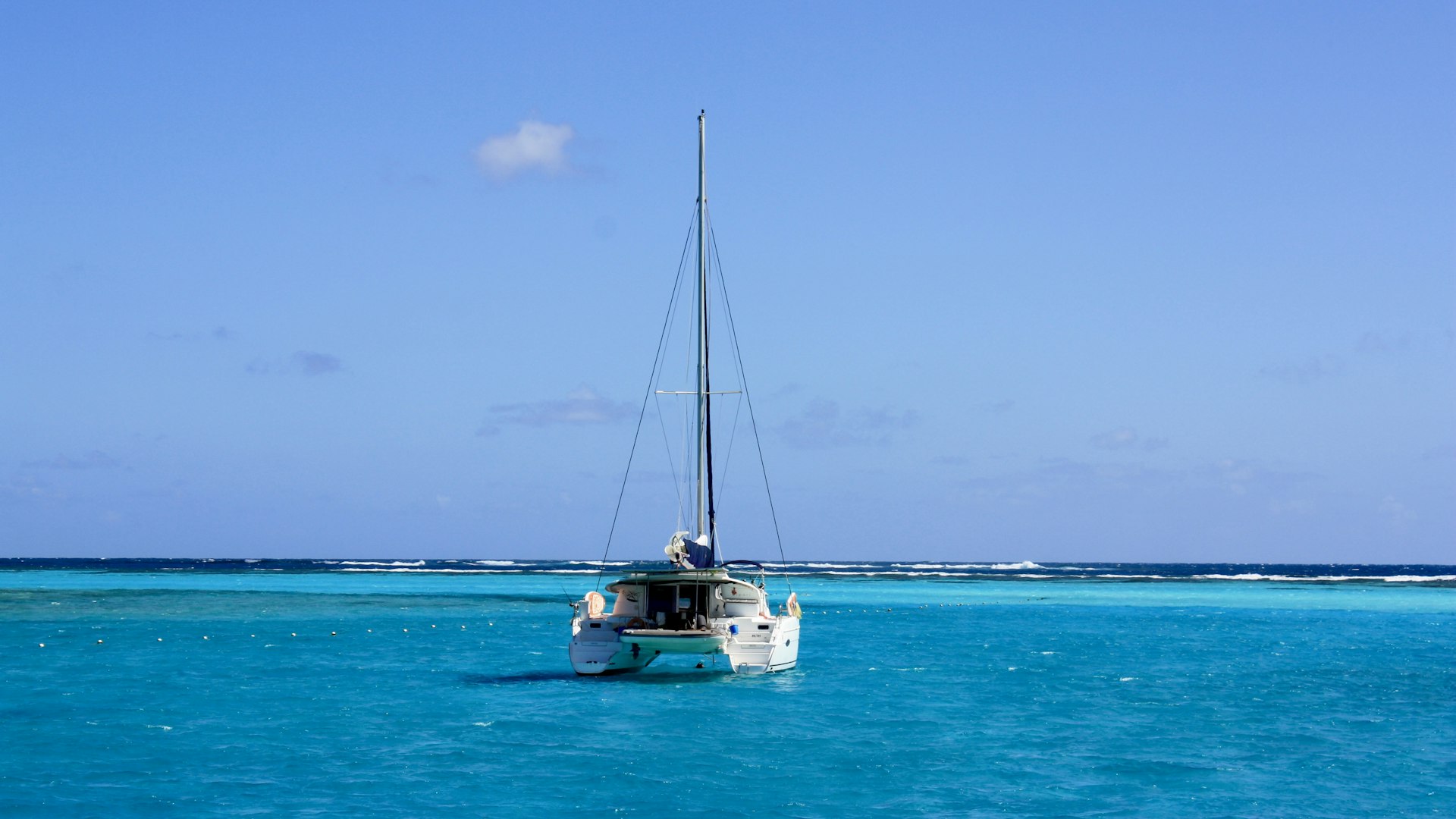
Catamaran Charter Croatia

Catamaran Charter Croatia

Croatia's Dalmatian coast stretches over 1,700 kilometres of mainland shoreline and more than a thousand islands, offering catamaran charterers a rare combination of protected passages, crystalline anchorages, and a sailing season that runs from late April through to October.

Catamarans Available in Croatia

Browse our selection of catamarans available for charter in Croatia.

Bareboat Catamaran Lagoon 400
catamaran

Bareboat Catamaran Lagoon 400

Lagoon 400 S2 · 2012

12.2m 11 4

From

€2k/week

View →
Bareboat Catamaran Lagoon 380
catamaran

Bareboat Catamaran Lagoon 380

Lagoon 380 · 2015

11.6m 12 6

From

€2k/week

View →
Bareboat Catamaran SILBA
catamaran

Bareboat Catamaran SILBA

Lagoon 400 S2 Owners Version · 2014

12.0m 8 5

From

€2k/week

View →
Bareboat Catamaran Lagoon 400
catamaran

Bareboat Catamaran Lagoon 400

Lagoon 400 · 2010

12.0m 12 4

From

€2k/week

View →
Bareboat Catamaran Lagoon 450
catamaran

Bareboat Catamaran Lagoon 450

Lagoon 450 · 2012

13.4m 12 4

From

€2k/week

View →
Bareboat Catamaran Lagoon 39
catamaran

Bareboat Catamaran Lagoon 39

Lagoon 39 · 2015

11.7m 12 6

From

€2k/week

View →
Bareboat Catamaran Lagoon 39
catamaran

Bareboat Catamaran Lagoon 39

Lagoon 39

11.9m 12 4

From

€2k/week

View →
Bareboat Catamaran Bali 4.5
catamaran

Bareboat Catamaran Bali 4.5

Bali 4.5 · 2019

13.6m 6

From

€2k/week

View →
Bareboat Catamaran Lagoon 400 S2
catamaran

Bareboat Catamaran Lagoon 400 S2

Lagoon 400 S2 · 2016

12.2m 11 4

From

€2k/week

View →
Bareboat Power Catamaran Lagoon 40 Power Catamaran
catamaran

Bareboat Power Catamaran Lagoon 40 Power Catamaran

Lagoon 40 Power Catamaran · 2016

12.0m 4

From

€2k/week

View →
Bareboat Catamaran BALI 4.1
catamaran

Bareboat Catamaran BALI 4.1

Bali 4.1 · 2019

12.3m 8 4

From

€3k/week

View →
Bareboat Catamaran Lagoon 380
catamaran

Bareboat Catamaran Lagoon 380

Lagoon 380 · 2013

11.6m 4

From

€3k/week

View →
Bareboat Catamaran Nautitech 40 Open
catamaran

Bareboat Catamaran Nautitech 40 Open

Nautitech 40 Open · 2016

12.0m 12 4

From

€3k/week

View →
Bareboat Catamaran Lucia 40
catamaran

Bareboat Catamaran Lucia 40

Lucia 40 · 2019

11.9m 6 3

From

€3k/week

View →
Bareboat Catamaran Lagoon 450
catamaran

Bareboat Catamaran Lagoon 450

Lagoon 450 · 2016

13.6m 6

From

€3k/week

View →
Bareboat Catamaran Lagoon 450
catamaran

Bareboat Catamaran Lagoon 450

Lagoon 450 · 2015

14.0m 5

From

€3k/week

View →
Bareboat Catamaran CATTARINA II
catamaran

Bareboat Catamaran CATTARINA II

Lagoon 39 · 2014

11.7m 10 6

From

€3k/week

View →
Bareboat Catamaran Lagoon 400
catamaran

Bareboat Catamaran Lagoon 400

Lagoon 400 · 2013

12.0m 12 4

From

€3k/week

View →
Bareboat Catamaran RAPALA
catamaran

Bareboat Catamaran RAPALA

Lagoon 400 S2 · 2014

12.0m 10 6

From

€3k/week

View →
Bareboat Catamaran FIND US
catamaran

Bareboat Catamaran FIND US

Lagoon 42 · 2021

12.8m 6 3

From

€3k/week

View →
Bareboat Catamaran Nautitech 40 Open Super Premier
catamaran

Bareboat Catamaran Nautitech 40 Open Super Premier

Nautitech 40 Open · 2016

12.0m 4

From

€3k/week

View →
Bareboat Catamaran Lagoon 400 S2
catamaran

Bareboat Catamaran Lagoon 400 S2

Lagoon 400 S2 · 2016

11.0m 12 6

From

€3k/week

View →
Bareboat Catamaran Lagoon 400
catamaran

Bareboat Catamaran Lagoon 400

Lagoon 400 · 2012

12.0m 6

From

€3k/week

View →
Bareboat Catamaran Lagoon 400
catamaran

Bareboat Catamaran Lagoon 400

Lagoon 400 · 2011

12.0m 4

From

€3k/week

View →

Chartering a catamaran in Croatia places you in one of the Mediterranean's most geographically rewarding cruising grounds. The Dalmatian archipelago — from the Kornati National Park in the north through to the Elaphiti Islands south of Dubrovnik — delivers a consistent rotation of walled medieval towns, deserted coves, and fish restaurants that source their catch from the same waters you anchored in overnight. The logistics work in your favour too: marinas are well-maintained, VHF coverage is reliable, and the ACI network alone runs to 22 ports.

The catamaran format suits this coastline particularly well. Croatia's inshore passages are largely sheltered from the open Adriatic, which means the shallow draught and wide beam of a modern catamaran can be used for genuine comfort rather than just rough-weather stability. Families benefit from the deck space; larger groups appreciate the privacy of separate hulls; and anyone who has spent a summer night on a monohull in a crowded marina will understand the appeal of swinging at anchor in your own bay instead.

Why Charter in Catamaran charter in Croatia

The Maestral and the Bora define Croatian sailing. The Maestral — a north-westerly sea breeze — fills in reliably from mid-morning through the afternoon across the central and southern Dalmatian channels between June and September, offering consistent sailing of 12 to 18 knots without the chaos of an offshore passage. The Bora, a cold katabatic north-easterly, arrives with little warning particularly in the Velebit Channel and around the Kornati, but a well-planned itinerary that keeps one eye on the DHMZ forecast avoids most of its inconveniences. For catamarans, whose windage can be a factor in tight conditions, understanding these two winds is the starting point of any good passage plan.

Croatia's UNESCO World Heritage credentials are genuine rather than bureaucratic. Diocletian's Palace in Split — still a functioning neighbourhood inside Roman walls — is ten minutes from the ACI Marina Split. The old city of Dubrovnik, accessible from the ACI Marina Dubrovnik at Komolac, rewards an early morning walk before the day-trippers arrive. Hvar Town, Korčula, and Trogir each carry the same depth of Venetian and Illyrian history, available to a charterer who can time their arrival for late afternoon when the tour groups have left.

Provisioning is straightforward from any of the main bases. Split, Trogir, and Dubrovnik all have large supermarkets within reasonable reach of the marina, and the fish markets in Split's Pazar and Dubrovnik's Gruž harbour are worth factoring into a morning schedule. Customs requirements for EU-flagged yachts are minimal; non-EU charterers will need a valid cruising permit (plovidbena dozvola), which your broker arranges as part of the booking. Fuel is readily available at most larger marinas.

Catamaran charter in Croatia Highlights

1

Kornati National Park — 89 islands covering 320 square kilometres of karstic terrain and turquoise water, with moorings managed by the Park authority and a handful of konoba restaurants accessible only by boat.

2

Vis Island and Stiniva Cove — Croatia's furthest inhabited offshore island, former Yugoslav military base, now home to some of the country's best winemakers (Plavac Mali and Vugava grapes) and the enclosed pebble bay at Stiniva, approachable by catamaran at slow speed.

3

Hvar Town and the Pakleni Islands — the Pakleni chain immediately west of Hvar Town provides sheltered anchorages with walkable access to good restaurants at Palmižana and Vinogradišće; Hvar itself rewards an evening ashore.

4

Mljet National Park — western Mljet's two saltwater lakes, Malo and Veliko Jezero, can be entered by dinghy; the island also has some of the best cycling and walking of the Dalmatian islands.

5

Korčula Old Town — the Venetian grid plan of Korčula Town is among the best-preserved in the Adriatic; anchor in Luka Korčula and walk to the Marco Polo Museum or catch a Moreška sword-dance performance in season.

6

Dubrovnik's outer islands — the Elaphiti Islands (Šipan, Lopud, Koločep) sit within easy reach of ACI Marina Dubrovnik and offer a low-key counterpoint to the city itself; Šipan's port of Šipanska Luka is particularly calm for an overnight stop.

7

Trogir and the Kaštela Bay — a UNESCO World Heritage site that most charterers pass through quickly on the way south; those who slow down find an extraordinary density of Romanesque and Renaissance architecture within walking distance of the town quay.

When to Sail

The core sailing window runs from May to October, with July and August delivering the most reliable Maestral winds and warmest sea temperatures, and May, June, and September offering a more composed version of the same experience with fewer boats in the anchorages.

High Season (Jun-Sep)

Sea temperatures reach 24 to 27°C by July and hold through August. The Maestral blows with textbook regularity, typically 15 knots by noon and easing by early evening — ideal for day-sailing between islands without needing to push hard. The trade-off is marina availability: popular anchorages at Stiniva on Vis, Palmižana on Pakleni Islands, and the town quay in Korčula fill early. Book your preferred stops at ACI marinas in advance and plan to anchor out on alternate nights. Provisioning, restaurants, and harbour services are all at peak capacity.

Shoulder Season (May, Oct)

May and October are increasingly popular with experienced charterers who prioritise quieter anchorages and lower base rates over guaranteed sunshine. Air temperatures in May sit around 20 to 23°C; October can dip to 17°C in the evenings, which rewards anyone who packs a fleece. Wind patterns in May include a higher frequency of Bora episodes than high summer, so passage planning needs more attention to weather windows. The Kornati in particular is extraordinary in late September and early October when the light changes and the crowds have gone.

Choosing the Right Yacht

A catamaran is arguably the most logical charter vessel for the Dalmatian coast, and the reasoning is practical. The inshore channels — the Šibenik, Split, and Hvar channels in particular — offer sufficiently consistent breeze to sail properly, while the protected waters mean that the stability and deck space of a catamaran can be fully exploited rather than spent managing a pitching bow. For groups of six to twelve, the twin-hull layout provides cabin separation that a monohull of equivalent length simply cannot match, and the shallow draught opens up anchorages that a deep-keeled sailing yacht would have to approach cautiously or avoid entirely.

Seven Days Sailing the Central Dalmatian Islands from Split

A suggested week-long charter route

Day 1

Embark at ACI Marina Split (Spinut) or the marina at Trogir, depending on your base. After a vessel briefing and provisioning, depart early afternoon for the Pakleni Islands, approximately 35 nautical miles south-west of Split. Anchor at Vinogradišće or pick up a buoy at Palmižana. Dinner at one of the Pakleni konobas, which serve grilled fish and local Hvar wines without the pricing of Hvar Town itself.

Day 2

Morning walk or swim before catching the Maestral westerly that typically fills in by 1000. Sail south-west to Vis Island (approximately 20 nautical miles). Anchor in Vis Town harbour or pick up a buoy in Komiža on the island's western side. Visit a local winery — Winery Saints Hills and Winery Lipanović both offer tastings — and dine ashore.

Day 3

Explore Stiniva Cove by dinghy in the morning when it is quietest (the catamaran is too wide for the entrance itself). Depart mid-morning south-east for Korčula Island. Anchor in Luka Korčula or take a berth on the town quay. Evening walk through the old town; if timing aligns, the Monday and Thursday Moreška performances run throughout summer.

Day 4

Sail east to Mljet National Park (approximately 25 nautical miles). Anchor in Polače bay on the northern coast — well-sheltered and close to the national park entrance — or proceed to Pomena on the western tip. Purchase park entry tickets and take the dinghy or kayak into Malo Jezero. The Benedictine monastery on the lake island is accessible by a small ferry from the park.

Day 5

A longer passage day: 55 nautical miles east to Dubrovnik. The Pelješac Channel runs between the peninsula and the islands and provides a mostly sheltered route. Time arrival at ACI Marina Dubrovnik (Komolac) for early afternoon. Arrange a water taxi into the old city for the evening — the walk along the city walls is best done at opening time (0800) before the heat and crowds build, so plan accordingly.

Day 6

Depart Dubrovnik north-west to the Elaphiti Islands. Šipanska Luka on Šipan (approximately 16 nautical miles from Komolac) offers a calm, well-protected overnight anchorage with a handful of small restaurants on the quay. The island has no cars; walking or cycling between the two settlements — Šipanska Luka and Suđurađ — takes around 45 minutes each way through olive groves.

Day 7

Return passage north-west via Korčula or Hvar depending on conditions and remaining time. If the Maestral is running, this is a rewarding upwind or beam-reach sail through the Hvar Channel. Arrive back at Split or Trogir by late afternoon in preparation for disembarkation. The marina at Trogir is worth a final evening ashore — the town centre is five minutes on foot from the berth.

Local Tips

  • The cruising permit (plovidbena dozvola) is mandatory for all foreign-flagged yachts in Croatian waters and must be arranged before departure — your charter broker handles this as part of the booking process. Keep it aboard alongside the vessel's registration documents at all times; port captains do conduct checks.
  • ACI marina berths book out quickly in July and August, particularly in Hvar, Korčula, and Dubrovnik. If your itinerary depends on a specific town berth on a specific night, reserve it at least two weeks in advance via the ACI portal. Build in at least two or three nights on anchor to give yourself flexibility.
  • Croatian konoba culture rewards unhurried dining. Most good fish restaurants outside the main tourist centres do not take bookings and operate on a first-come basis; arriving before 1900 almost always secures a table. Order prstaci (date mussels) only if the restaurant is clearly reputable — the shellfish are protected, and their presence on a menu is occasionally a sign of shortcuts elsewhere.
  • Fuel and water are available at most ACI marinas and at many town quays. Diesel in Croatia is priced in kunas (now euros following Croatia's 2023 adoption of the single currency) and is broadly in line with other Adriatic destinations. Top up at larger marinas rather than waiting for smaller island stops where fuel may not be available.
  • The DHMZ weather service (Državni hidrometeorološki zavod) is the Croatian national meteorological authority and offers the most reliable local forecasts, including the Adriatic coastal bulletins broadcast on VHF channel 67 at set intervals. Cross-reference with Windy or PredictWind, but the DHMZ Bora warnings should be taken seriously regardless of what other sources say.
  • Plastic waste in Croatian waters is a growing concern, particularly around the Kornati and the northern Dalmatian islands. Many anchorages now display request signs asking visitors to carry their rubbish to the next marina rather than using the limited local collection facilities. Several charter guests bring reusable provisioning bags and onboard separation bins as a matter of course.

Frequently Asked Questions

Do I need a sailing licence to charter a catamaran in Croatia+
Croatia requires the skipper to hold a nationally recognised sailing qualification — the RYA Day Skipper certificate (or equivalent) is accepted. You will also need a valid VHF radio operator's licence (the RYA Short Range Certificate covers this). If you are chartering with a professional skipper, these requirements fall to them. Proof of qualifications is checked at the port captain's office when collecting your cruising permit.
Which is the best base for a catamaran charter in Croatia+
Split and Trogir are the most practical bases for central Dalmatian itineraries and have the largest selection of catamarans available. Both are within easy sailing distance of the Kornati, Vis, Hvar, and Korčula. Dubrovnik works well for southern itineraries focusing on the Elaphiti Islands and Montenegro. Šibenik is increasingly popular for access to the Kornati from the north.
What is the best catamaran size for a family of six in Croatia+
A 44 to 50-foot catamaran — such as the Lagoon 450F or a Fountaine Pajot Elba 45 — is well-suited to six adults or two families with children. This size provides four cabins, manageable handling for a skippered or bareboat charter, and sufficient deck space for comfortable day-sailing. The Kornati moorings and most Croatian anchorages accommodate this beam without difficulty.
How far in advance should I book a catamaran charter in Croatia+
For July and August, six to nine months in advance is realistic if you have specific preferences about yacht model, cabin count, or base. The most capable catamarans in the 50-foot-plus range are often reserved by January for peak summer. May, June, September, and October bookings are frequently possible with two to three months' lead time, though the better vessels still go early.
Is Croatia suitable for first-time catamaran charterers+
Yes, with some qualification. The protected inshore channels reduce the risk of open-ocean conditions, and the well-organised ACI marina network means there is always a port of refuge within reasonable range. First-timers are strongly advised to charter with a professional skipper for at least the first trip, both for safety and to make the most of the local knowledge that a good skipper brings. Bareboat charter is best attempted by those with demonstrable experience in comparable conditions.
Are Croatian marinas equipped to handle large catamarans+
Most ACI marinas can accommodate catamarans up to 8 to 9 metres beam, which covers the majority of charter vessels up to around 60 feet. Larger catamarans — Sunreef 80 and above — require advance arrangement, and some smaller town quays are not suitable at all. If you are chartering a larger vessel, confirm berth suitability with the specific marina before finalising your itinerary.

Tell our brokers your preferred dates and group size and we will shortlist the most suitable catamarans from our Croatia fleet within 24 hours.

Request Your Charter

Request Your Charter

Tell us about your dream voyage and we will find the perfect yacht for you.