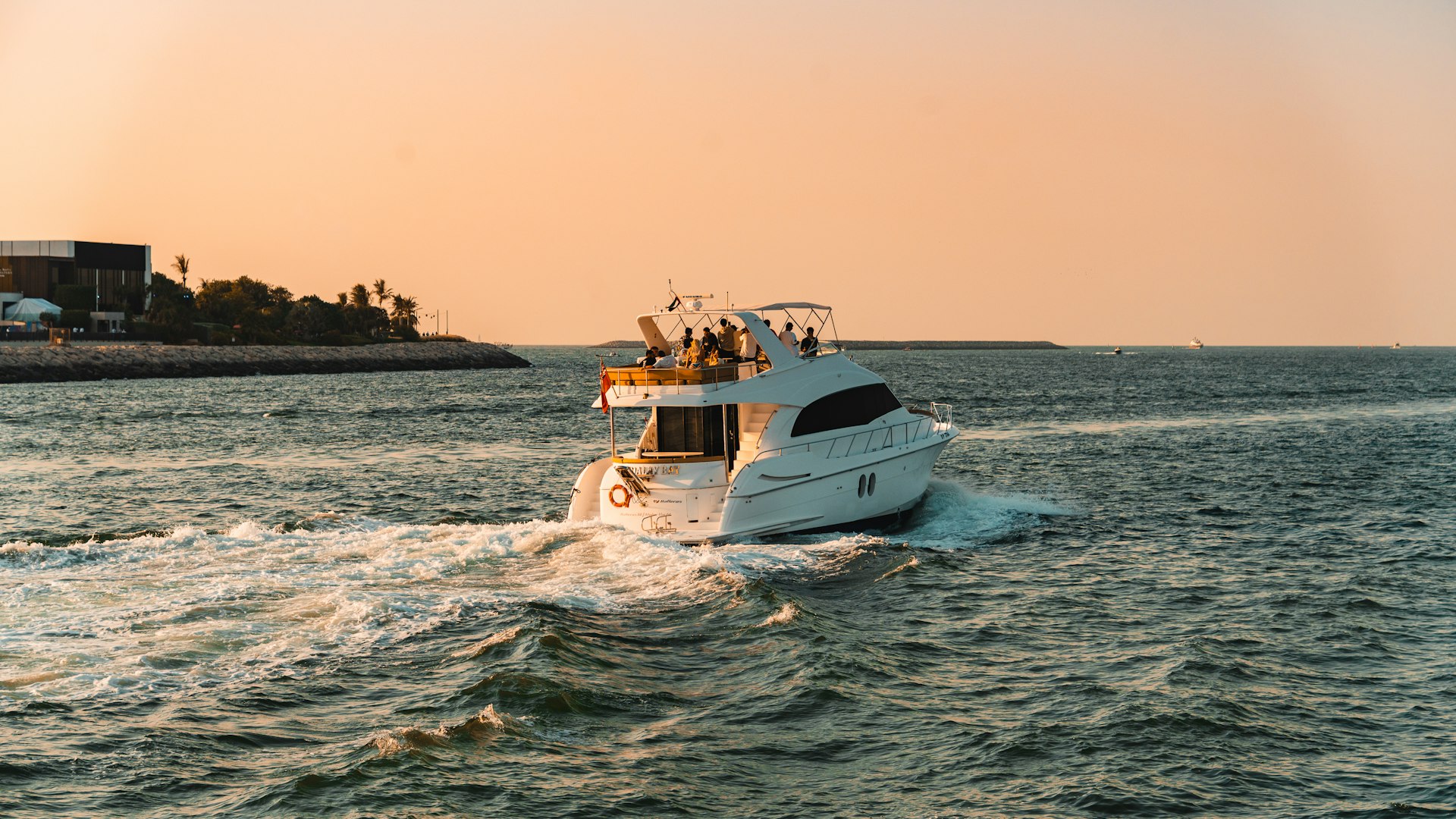
Motor Yacht Charters

Motor Yacht Charters

From a **46-foot Sunseeker** on the Amalfi Coast to a 150-guest superyacht crossing the Pacific, motor yacht charter puts the world's coastlines within reach on your own terms and timeline.

Motor yacht charter is, at its core, a question of priorities. You want range, speed, and space in equal measure, and you want the freedom to cover ground without trimming sails or reading weather windows with the same anxiety a bluewater sailor must. A well-chosen motor yacht delivers all three. The global fleet available through SelectYachts spans compact 23-foot centre consoles suited to island-hopping in the Exumas, through to full-displacement superyachts from yards such as Abeking & Rasmussen and ADM Shipyards that cross oceans in comfort and arrive with beach clubs, helipads, and formal dining rooms intact.

What separates a considered motor yacht charter from an impulsive booking is understanding how hull form, range, crew-to-guest ratio, and regional regulations interact. A planing hull Pershing 90 will consume far more fuel per nautical mile than a semi-displacement Azimut of similar length, which matters acutely in remote destinations where bunkering is expensive or infrequent. The notes below are written for charterers who already understand the fundamentals and want a sharper framework for choosing the right vessel, the right season, and the right waters.

Why Charter in Motor Yacht charter worldwide

The worldwide motor yacht fleet is the most diverse charter category on the water. Over 1,500 vessels are available across every major cruising ground, meaning that whether your objective is a week in the Croatian islands, a month circumnavigating the Maldivian atolls, or a private crossing from Antibes to Palma, the right hull almost certainly exists and is available to charter. No other category offers this breadth simultaneously with genuine luxury.

Motor yachts also give experienced charterers schedule certainty that sailing yachts cannot always match. Passages that take two days under sail can be completed overnight under power, allowing longer time at anchor in the places that matter most. For families with children, corporate groups, or clients whose shore commitments limit their window afloat, this is not a minor convenience but a decisive factor. A 20-knot passage speed compounds across a week's itinerary into two or three additional anchorages.

The range of hull types and yard pedigrees available is genuinely global. Italian yards such as Absolute, Aicon, and Admiral produce vessels optimised for Mediterranean summer conditions and Adriatic manoeuvring. Northern European yards including Abeking & Rasmussen build for blue-water range and North Atlantic stability. AB Yachts and Alfamarine sit at the performance end of the spectrum. Understanding yard philosophy before shortlisting a vessel saves significant time and disappointment on charter.

Motor Yacht charter worldwide Highlights

1

The Aeolian Islands, Sicily: seven distinct volcanic islands within a compact 40-nautical-mile arc, each with contrasting anchorages, from the sulphurous fumaroles of Vulcano to the black-sand bays of Stromboli. A motor yacht's speed makes a full circuit genuinely achievable in a week.

2

The Dalmatian Coast, Croatia: Hvar, Vis, Korčula, and the Kornati National Park offer a combination of medieval harbour towns and uninhabited island anchorages. The Bora and Jugo winds are the dominant weather factors; local knowledge matters for finding protected overnight anchorages.

3

The British Virgin Islands: Sir Francis Drake Channel is one of the world's most navigable cruising grounds, with short passages between Tortola, Virgin Gorda, Jost Van Dyke, and Anegada. The Baths at Virgin Gorda and the Anegada reef system are specific objectives no itinerary should omit.

4

The Maldivian Atolls: the outer atolls of Baa, Lhaviyani, and the Huvadhu Atoll offer serious diving and a stark contrast to the crowded central atolls around Malé. Larger displacement motor yachts capable of carrying multiple dive tenders are better suited here than planing hulls optimised for speed.

5

The Norwegian Fjords: Geirangerfjord, Nærøyfjord, and the Hardangerfjord are navigable from late May through September. The experience of transiting a fjord at slow speed aboard a motor yacht with open deck space is qualitatively different from any Mediterranean passage. Freshwater waterfalls cascade directly into the fjord system and are accessible by tender in ways impossible from a cruise ship.

6

The Whitsundays, Australia: Whitehaven Beach on Whitsunday Island and the reef passages of the outer Barrier Reef require planning around tidal currents in the Whitsunday Passage, but a well-briefed captain aboard a capable motor yacht can navigate the inner route comfortably. The Coral Sea light in June and July is exceptionally clear.

7

The Greek Dodecanese and Turkish coast: the combination of Greek island hopping from Rhodes to Kos, Patmos, and Symi, followed by a transit into Turkish waters to visit Göcek, Bodrum, and the Gulf of Hisarönü, creates one of the most varied charter itineraries available. Turkish marinas including Göcek and Marinturk Bodrum are well-equipped for provisioning large motor yachts.

When to Sail

Motor yacht charter has no single global season because the destinations are themselves so varied. The Mediterranean peaks from June through September, the Caribbean and Indian Ocean operate on inverse winter schedules, and destinations such as Norway, Patagonia, and the South Pacific each follow entirely different weather calendars.

High Season (Jun-Sep)

The Mediterranean is at full tempo from mid-June through early September: the Mistral and Meltemi are predictable if occasionally strong, marinas in Ibiza, Portofino, and Mykonos demand advance booking and charge peak rates, and provisioning infrastructure is at its most reliable. The Caribbean high season runs December through April, when trade winds provide consistent 15-20 knot conditions and rainfall is minimal across the Leewards, Windwards, and BVIs. In Southeast Asia, the Andaman Sea and Gulf of Thailand operate on a reversed monsoon pattern, with the western coast of Thailand and the Mergui Archipelago most accessible from November through April.

Shoulder Season (May, Oct)

May and October are often the most rewarding months for experienced charterers in the Mediterranean. Marinas are less pressured, berth availability improves, and the light in the Western Med and Adriatic is noticeably more interesting photographically. Water temperatures in the Western Mediterranean remain comfortable through October. In the Caribbean, October marks the tail of hurricane season and is treated cautiously, though the Grenadines and ABC islands sit largely outside the primary hurricane belt and see more year-round charter activity than their northern neighbours. For Indian Ocean destinations, May and October represent transitional monsoon periods requiring careful weather routing, particularly in the Maldives and Seychelles where inter-atoll passages can be exposed.

Choosing the Right Yacht

For the Mediterranean and Caribbean, semi-displacement motor yachts in the 65-100 foot range offer the most practical balance of interior volume, fuel economy, and ability to access shallow anchorages by tender. Models such as the Sunseeker 90 Ocean represent a mature point in the category: serious range without the operating costs of full-displacement superyacht hull forms. Where guests number eight or fewer and the primary objective is destination coverage rather than onboard entertaining, a planing hull in the 50-70 foot range from yards such as Absolute or Aicon will deliver better passage times and lower weekly rates.

Seven Days in the Aeolian Islands and Northern Sicily

A suggested week-long charter route

Day 1

Depart Palermo or embark from the Marina di Palermo in the late afternoon following provisioning. Transit overnight or early morning northeast towards Vulcano. A motor yacht at cruising speed covers the 90 nautical miles comfortably in five to six hours, allowing a morning arrival at Porto di Levante.

Day 2

Anchor at Vulcano's Gelso anchorage on the southern coast for morning swimming and snorkelling. The sulphurous mud pools at Porto di Levante are a specific curiosity worth an hour ashore. Afternoon transit north to Lipari, the archipelago's main town, for an overnight berth at the marina and dinner in the town.

Day 3

Day passage northwest to Filicudi and Alicudi, the two most remote western islands. Both are small enough to circumnavigate by tender. Alicudi in particular has no cars and minimal tourist infrastructure; the sense of removed calm is striking. Overnight at anchor off Filicudi Porto.

Day 4

Transit east to Panarea, the smallest and most fashionable of the inhabited islands. Anchor in the main bay south of San Pietro village. Bronze Age village ruins sit on the promontory above the town. The channel between Panarea and the uninhabited islets of Dattilo and Lisca Bianca offers good snorkelling over volcanic rock formations.

Day 5

Morning approach to Stromboli for a daytime anchorage below the active crater. The island produces near-continuous small eruptions visible from deck, particularly after dusk. Most captains anchor on the northern or western side depending on conditions. The Sciara del Fuoco lava field on the northwestern flank is a specific visual reference. Depart late evening southward.

Day 6

Arrive at Salina, the second-largest island and the most agriculturally productive, known for Malvasia delle Lipari, a passito-style sweet wine produced in small quantities on the island's eastern terraces. Anchor at Rinella or Santa Marina for provisioning. Day use of tenders for exploration of the coastline between Lingua and Malfa.

Day 7

Final morning at Salina before a direct transit south to Milazzo on the Sicilian coast for disembarkation, or continue west along the northern Sicilian coast towards Palermo if the charter began there. The passage along Sicily's Tyrrhenian coast passes the ancient town of Cefalù, where a brief tender landing for lunch near the Norman cathedral is easily arranged before final arrival.

Local Tips

  • Advance marina reservations are non-negotiable in the Mediterranean between mid-July and mid-August. Marinas at Portofino, Porto Cervo, Ibiza Harbour, and Capri operate years-long waiting lists for peak-season berths. A competent broker will address this before contract signature, not after.
  • Bunkering logistics vary significantly by destination. In Croatia, fuel is available at most larger marinas but surcharges for large tanks apply. In the Maldives and outer Pacific islands, fuel must frequently be pre-arranged through local agents and delivered by jerry cans or barge to anchorages. Budget accordingly for remote itineraries.
  • Entry formalities for private charter yachts are not uniform even within the EU. Croatia requires a specific navigation permit (Croatian Cruising Licence) for all charter vessels. Turkey requires a transit log obtained on arrival. Greece has its own TEPAI cruising tax applicable to charter vessels over a certain length. Your captain and broker should handle these, but it pays to confirm this explicitly in advance.
  • Provisioning quality varies sharply by port. Antibes, Palma de Mallorca, and Fort Lauderdale have mature yacht provisioning industries with cold-chain delivery to the marina. In the outer Greek islands, the Grenadines, or the more remote Indonesian archipelagos, provisioning requires 48-72 hours' advance notice and creative sourcing. Guest dietary requirements must be communicated to the captain well before embarkation.
  • Tipping norms differ by cruising ground. In the Mediterranean, 10 per cent of the base charter fee is standard for a well-performing crew and is generally distributed by the captain. In the Caribbean, 15 per cent is more common. In Southeast Asia, norms are less formalised but a thoughtful tip is always appreciated. Cash in the local currency or US dollars is preferred in most jurisdictions.
  • Tender and water toy insurance is typically included in the yacht's standard policy but has a bearing on which activities the captain will sanction. Jet ski use near protected marine areas in Croatia, for example, carries specific restrictions. Confirming what water sports are permitted within the insured operating area avoids frustration mid-charter.

Frequently Asked Questions

What is the realistic weekly budget for a motor yacht charter for eight guests+
For eight guests in genuine comfort aboard a well-equipped motor yacht of 65-90 feet, $30,000 to $90,000 per week covers the base charter fee across most Mediterranean and Caribbean cruising grounds. The median across the SelectYachts motor yacht fleet sits around $54,000 per week. This figure excludes Advance Provisioning Allowance (APA), which typically adds 25-35 per cent on top for fuel, food, drinks, marina fees, and port taxes. Total trip cost for a week at the $54,000 charter fee level therefore often lands between $70,000 and $80,000 all in.
How does fuel consumption affect the total charter cost on a motor yacht+
Fuel is the largest single variable cost in motor yacht charter. A planing hull vessel running at 20-25 knots will consume 150-300 litres per hour depending on size and load. A semi-displacement or displacement hull travelling at 10-12 knots may consume 50-100 litres per hour. Over a week's charter with daily passages, the difference compounds significantly. For itineraries involving substantial transit distances, a semi-displacement hull is almost always more economical. Your charter contract should specify the APA expectation and what happens if fuel costs exceed the estimate.
Can a motor yacht charter cross an ocean or is it restricted to coastal cruising+
Full-displacement superyachts from yards such as Abeking & Rasmussen are built for oceanic passages and transit the Atlantic, Pacific, and Indian Oceans regularly. Coastal motor yachts in the 50-90 foot range are generally not suited to open-ocean passages of more than 400-500 nautical miles without careful weather routing and experienced offshore crew. If your itinerary requires a transatlantic or transpacific leg, specify this explicitly at enquiry stage so vessels with appropriate range, stability certification, and crew experience can be shortlisted.
What is the difference between a crewed and bareboat motor yacht charter+
Virtually all motor yacht charters above 50 feet are fully crewed arrangements, meaning the captain, engineer, chef, and deck crew come with the vessel. Bareboat motor yacht charter is available on smaller vessels in some jurisdictions (notably the BVIs, Greece, and Croatia) and requires proof of competence certification. For the typical SelectYachts client chartering in the $20,000-plus per week bracket, crewed charter is the relevant product. The crew manage all navigation, provisioning, engineering, and service; guests arrive and depart without operational responsibilities.
How far in advance should a motor yacht charter be booked+
For peak weeks in the Mediterranean (last two weeks of July and first two weeks of August), six to twelve months ahead is prudent for vessels in the $50,000-plus per week bracket. The same applies to the Caribbean between Christmas and New Year. Outside these windows, four to eight weeks' lead time is often sufficient in shoulder months, and last-minute availability does occasionally arise. However, the specific vessels clients want, with the right crew and confirmed berths in the right marinas, are rarely available on short notice during peak season.
Is a motor yacht or a sailing yacht more appropriate for a first charter+
For guests whose priority is destination experience over sailing activity, motor yachts remove the variables of wind dependency, heel, and weather-driven schedule changes that can unsettle first-time charterers. A capable, enthusiastic crew aboard a well-appointed motor yacht can deliver a consistently comfortable week regardless of wind conditions. Guests who want to participate actively in sailing, or for whom the sailing itself is part of the attraction, should consider a sailing yacht. The two products attract different client profiles for good reason.

**Speak with a SelectYachts charter specialist** to match your destination, dates, and guest count to the right motor yacht from our worldwide fleet.

Request Your Charter