Indonesia Yacht Charters
From the volcanic anchorages of Komodo to the remote reefs of Raja Ampat, Indonesia rewards those who arrive by sea with access that no land-based itinerary can match. This is one of the world's most geographically complex cruising grounds, spanning over 17,000 islands across six degrees of latitude.
Charter by Vessel Type in Indonesia
Catamaran Charter in Indonesia
Spacious twin-hull vessels offering stability, comfort, and generous deck space for the ultimate charter experience.
Sailing Yacht Charter in Indonesia
Classic sailing vessels that combine timeless elegance with the thrill of wind-powered adventure.
Motor Yacht Charter in Indonesia
Powerful luxury vessels delivering speed, sophistication, and effortless cruising across any waters.
Available Yachts in Indonesia

Bareboat Sailing Yacht Bali 4.5
Bali 4.5 · 2017
From
$5k/week

Bareboat Catamaran Bali 4.5
Bali 4.5 · 2020
From
$7k/week

Catamaran POINT CLEAR
Bali 4.4 · 2023
From
$14k/week

Crewed Catamaran FIRST TRACKS
Bali 4.6 · 2023
From
$18k/week

Crewed Catamaran MAGNIFICENT
Bali 4.8 · 2022
From
$20k/week

Crewed Catamaran ANNETTE2
Sunreef 60 · 2017
From
$26k/week

Luxury Crewed Sailing Yacht Indonesian Honeymoon Cruise
Phinisi
From
$31k/week

luxury Crewed Sailing Yacht RAJA
Custom Built · 2006
From
€33k/week

Luxury Crewed Sailing Yacht Phinisi 40 KAT
Custom Built · 1995
From
$38k/week

Luxury Crewed Motor Yacht KAYRA
Phinisi 38m · 2025
From
$42k/week

luxury Crewed Sailing Yacht Phinisi 34 TB
Phinisi 34 · 2008
From
$43k/week

Luxury Crewed Sailing Yacht ORACLE
Phinisi 35m · 2019
From
$46k/week
Indonesia is not a single sailing destination but a constellation of them. The archipelago stretches from Sabang in the northwest to Merauke in the east, a distance greater than the width of the continental United States, encompassing the spice islands of Maluku, the surf breaks of Sumbawa, the Hindu temples of Bali, and the primeval forests of Kalimantan. A yacht is not merely convenient here — it is the only logical way to move between worlds that road and air simply cannot connect.
The cruising grounds divide broadly into three distinct theatres: the Bali and Nusa Tenggara corridor running east through Lombok, Sumbawa, and Flores towards Komodo; the Banda Sea and Maluku islands for those seeking genuine remoteness; and Raja Ampat in West Papua, now internationally recognised as one of the highest marine biodiversity zones on Earth. Each demands different preparation, different yacht capabilities, and a different relationship with the elements.
Why Charter in Indonesia
The underwater geography is the first reason serious charterers choose Indonesia. The Coral Triangle — the convergence zone of the Pacific and Indian Oceans centred on these waters — supports over 75 per cent of all known coral species and more than 3,000 species of reef fish. At sites like Boo Windows in Raja Ampat or the seamounts of the Banda Sea, the biodiversity encountered on a single dive exceeds what most divers encounter in a lifetime elsewhere. The upwellings that feed this life also drive the currents that make passages genuinely interesting — the Lombok Strait moves serious water at speed and requires attention to tides.
Culturally, the range across a single itinerary is extraordinary. A two-week charter running east from Bali might take guests through Balinese Hindu ceremony culture, past the animist villages of Flores, to a Komodo landing where the evolutionary anomaly of Varanus komodoensis goes about its business in the scrub. The local boatbuilding tradition — the Phinisi schooner, hand-built by the Konjo and Bugis peoples of South Sulawesi — is itself a reason to charter here: sailing on a vessel constructed using centuries-old techniques in the very waters it was designed for is an experience with few equivalents globally.
The provisioning and culinary dimension is underrated. Indonesian fish markets, particularly in Labuan Bajo and Ambon, operate at a quality level that surprises charterers expecting remote-destination compromise. Fresh yellowfin tuna, wahoo, coral trout, and lobster are available at prices that would be considered extraordinary in the Mediterranean. A skilled charter chef working these markets can construct menus that rival the best regional restaurants, drawing on the spice heritage of the Banda Islands — nutmeg, mace, and cloves grown in the same volcanic soil that once drove European colonial empires to map the known world.
Indonesia Highlights
Komodo National Park — Anchor at Gili Lawa Darat for elevated sunset views across the archipelago, then run the current-swept channels at Batu Bolong for drift diving among reef sharks, mantas, and Napoleon wrasse. The pink sand beach at Pantai Merah is a genuinely unusual anchorage.
Raja Ampat, West Papua — The Dampier Strait between Waigeo and Batanta concentrates nutrients that draw manta rays in numbers. Misool in the south offers extraordinary karst limestone scenery and near-total seclusion. Advance permits from the Raja Ampat government are mandatory and take planning.
The Banda Islands, Maluku — The cradle of the global spice trade, Banda Neira sits beneath an active volcano with a Dutch colonial fort on the waterfront. The surrounding sea is deep, clear, and almost entirely free of other charter yachts. Wall dives drop to over 200 metres.
Nusa Penida and the Nusa Islands, Bali — A 45-minute sail southeast from Benoa Harbour brings you to manta cleaning stations at Manta Point and reliable seasonal encounters with oceanic sunfish (Mola mola) from July to October. The cliff scenery above Kelingking Beach requires no underwater endorsement.
Labuan Bajo and the Flores coastline — This mainland Flores port has developed a sophisticated provisioning infrastructure for the charter market without losing its working-harbour character. The surrounding islands — Rinca, Padar, and the outer Komodo group — offer anchorages suitable for most conditions.
Wakatobi, Southeast Sulawesi — One of the most pristine reef systems remaining in the Coral Triangle, accessible to yachts drawing under 2.5 metres across the inner lagoon passes. The local Bajau communities maintain a sea-nomadic tradition and welcome respectful interaction.
The Gili Islands and Lombok Strait — Gili Trawangan, Gili Air, and Gili Meno provide relaxed overnight anchorages with easy access to Lombok's market towns and the extraordinary Senaru Trek approach to Rinjani volcano. The Lombok Strait itself offers one of the most technically interesting passages in the region, with tidal streams exceeding four knots at springs.
When to Sail
Indonesia's weather patterns are governed by the Southeast Asian monsoon system, which moves in opposing directions across different parts of the archipelago simultaneously. The dry season from May to October is optimal for the Bali-Komodo-Flores corridor; the same months can bring heavy swells to the south, while Raja Ampat in West Papua follows an inverse pattern, with its best conditions from October to April.
High Season (Jun-Sep)
The southeast trade winds (the Tenggara) blow steadily at 15-25 knots across the Bali-Komodo-Flores corridor from June through August, providing consistent and often exhilarating sailing conditions. Visibility underwater peaks during this period. Komodo's dragon population is active and accessible. The waters around Lombok and Sumbawa see good wave formation for surf-oriented charters. Raja Ampat, by contrast, is mid-wet season during these months and while diveable, can see extended periods of overcast skies and afternoon rain. Expect the highest demand — and therefore the earliest booking lead times — for Bali-based yachts during July and August.
Shoulder Season (May, Oct)
May and October represent the transition windows and often deliver the most balanced conditions across the widest range of destinations. Wind strengths moderate, crowds thin before the main European holiday exodus, and the light quality for photography is often superior. October in particular opens the door to beginning a Raja Ampat itinerary as the northwest monsoon builds towards its December-January peak in West Papua's surrounding seas. The shoulder months also coincide with key Balinese ceremonial calendar events, which can add unexpected cultural depth to a charter departure.
Choosing the Right Yacht
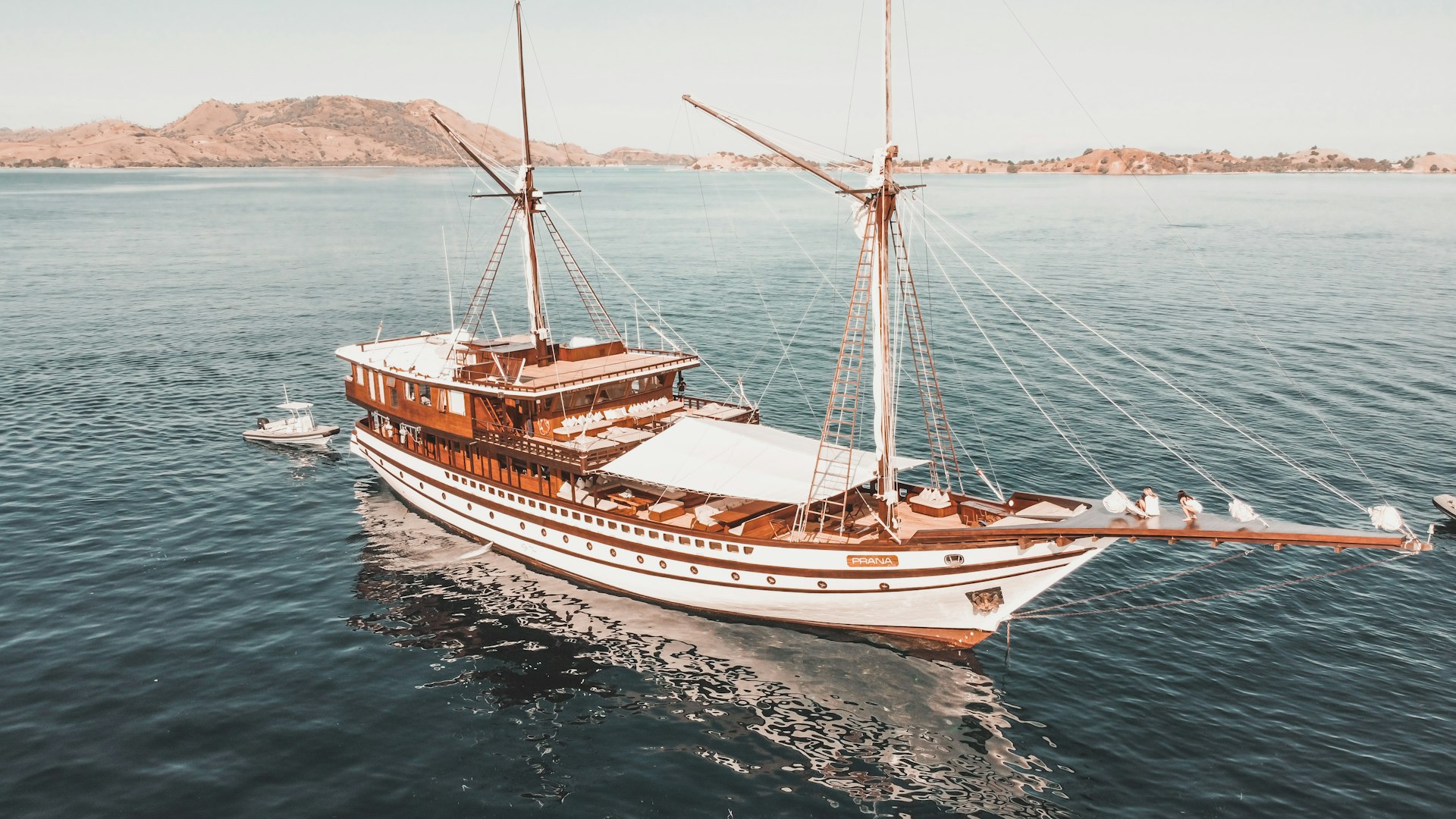
The Phinisi schooner is the vessel best matched to Indonesian waters by every measure: cultural resonance, deck space for diving and snorkelling operations, shallow draught for exploring bays that exclude deeper-keeled yachts, and the ability to carry the provisions and fuel necessary for extended offshore passages between the island groups. Vessels built by the Konjo and Bugis boatbuilders of South Sulawesi — some exceeding 40 metres — offer up to 16 guests genuine liveaboard comfort with the ability to anchor in locations no marina-dependent yacht could reach. Several contemporary Phinisi builds now incorporate air conditioning, stabilisers, and dive compressors as standard, bridging the gap between traditional aesthetics and current charter expectations.
Bali to Komodo — Ten Days Through the Lesser Sundas
A suggested week-long charter route
Board in Benoa Harbour, Bali, and allow your captain to clear out formalities while the crew briefs the programme. The afternoon passage to Nusa Lembongan takes under two hours. Anchor in the bay north of Mushroom Bay before sunset. Nusa Penida is visible to the east. Dinner aboard using Bali's exceptional fresh produce from the Jimbaran fish market.
Early dive at Manta Point on Nusa Penida's southwest tip. Manta rays frequent the cleaning station year-round; from July to October there is a reasonable chance of encountering Mola mola in the blue water off Crystal Bay. Return to the yacht for lunch underway as you pass through the Lombok Strait, timing the transit for the favourable tidal window. Anchor at Gili Air by evening.
A rest morning at Gili Trawangan with snorkelling on the reef that fringes the island's northeast. The Gili islands operate motor vehicle bans — cidomo horse carts and bicycles only — which gives the place an unusual unhurried quality. Afternoon passage south along the Lombok coast, noting the dramatic Rinjani ridgeline to the east. Overnight anchor at Teluk Ekas, a protected bay used by local fishing fleets.
Long passage day east along the Sumbawa coast, with open water sailing in the Tenggara trades. This is the sailing day: set canvas, establish watches, and let the wind do its work. The north Sumbawa coast is largely empty of development. Anchor in a sheltered bay near Bima by late afternoon, a significant town and good re-provisioning point.
Transit the Sape Strait between Sumbawa and Flores, a passage that concentrates Indian Ocean swell and requires careful timing at the narrows. Once through, the character of the sea changes — the water freshens to a deeper blue, and the volcanic cones of Flores begin to organise themselves on the horizon. First anchorage in the outer Komodo group at Gili Banta.
Enter Komodo National Park properly, with permits arranged in advance through your charter broker. Morning dive at Batu Bolong, widely considered one of the finest dive sites in Indonesian waters: a seamount swept by current that concentrates every tier of the food chain. Afternoon at Pantai Merah (Pink Beach), the pink-hued shoreline resulting from red coral fragments mixed into the sand. The colour is most vivid in mid-afternoon light.
Komodo Island and a ranger-accompanied dragon walk. Varanus komodoensis is large, venomous, and entirely indifferent to tourists — which makes encounters more compelling than any managed wildlife experience. The rangers are knowledgeable and attentive. Return to the yacht at Loh Liang anchorage for lunch. Afternoon on Padar Island, whose ridge trail offers a panoramic view across three bays of distinctly different water colours.
Rinca Island in the morning for a second dragon encounter — the Rinca population is reportedly more active and the landscape more open than Komodo proper. Afternoon transit to Manta Alley on the southern tip of Komodo Island, where a narrow channel reliably concentrates reef mantas year-round. Evening anchor in the calm of Gili Lawa Darat.
Sunrise from the hilltop above Gili Lawa Darat is worth the 30-minute climb in the pre-dawn. The view extends across the entire Komodo group with Flores in the background. Morning sail to Labuan Bajo for reprovisioning, fuel, and any crew requirements. The harbour front has developed a strong restaurant and craft market scene. Final night afloat in the bay.
Disembark in Labuan Bajo, where Komodo Airport handles direct connections to Bali and Jakarta. Most charter parties depart mid-morning, allowing a final breakfast aboard and a proper goodbye to the crew. Those with flexible schedules might consider an additional night before departure: the outer islands north of Labuan Bajo remain almost entirely unvisited and reward the curious.
Local Tips
- •Entry formalities require advance coordination. Foreign-flagged yachts must obtain a Cruising Permit (CAIT — Clearance Approval for Indonesian Territory) well before arrival, a process that involves multiple government agencies and is best managed through an experienced local agent in Bali or Jakarta. Your charter broker should coordinate this as part of the booking process, but confirm it explicitly.
- •Komodo National Park and Raja Ampat both require separate park entry permits purchased locally, and Raja Ampat additionally levies a conservation fee that funds reef protection programmes. Budget for these as incidentals; the conservation argument for paying them is genuine.
- •Fuel availability outside Bali, Labuan Bajo, and Sorong (the Raja Ampat gateway) is inconsistent. Experienced Phinisi captains plan fuel calculations conservatively and carry deck drums for remote itineraries. Confirm your vessel's range and carry capacity before committing to any routing that leaves these three ports more than 24 hours behind.
- •Indonesian cuisine aboard is a genuine asset. Rather than defaulting to a Western-focused menu, ask your chef to use local spice pastes (bumbu), fresh coconut, and the extraordinary range of tropical fish available in local markets. The Balinese spice tradition in particular translates beautifully to yacht catering: dishes built on galangal, lemongrass, turmeric, and candlenut are complex without being heavy in tropical heat.
- •Cultural respect in coastal villages matters practically as well as ethically. Many anchorages sit adjacent to Muslim fishing communities (the majority religion across most of Indonesia outside Bali). Dress modestly when going ashore, particularly during Ramadan. Bringing small practical gifts — good quality fishing line, reading glasses for elders — is a recognised courtesy that opens doors a cash economy cannot.
- •Diving equipment and gas fills are available at good standard in Bali, Labuan Bajo, and Sorong. Beyond these centres, availability is unpredictable. Serious dive-oriented charters should confirm that their vessel carries a compressor, and ensure the crew includes at least one qualified divemaster familiar with the specific sites on the itinerary, given that the current profiles in Komodo and the Banda Sea require competent local knowledge.
Frequently Asked Questions
Do I need a visa to arrive in Indonesia by private yacht+
What is the best base for joining a charter in Indonesia+
Is Indonesia suitable for inexperienced sailors or non-sailors+
How far in advance should I book a charter in Indonesia+
What should a realistic budget cover beyond the base charter fee+
Are Phinisi yachts as comfortable as European-built charter vessels+
Speak to our Indonesia specialists to match the right vessel to your preferred cruising ground, travel window, and group profile.
Request Your Charter