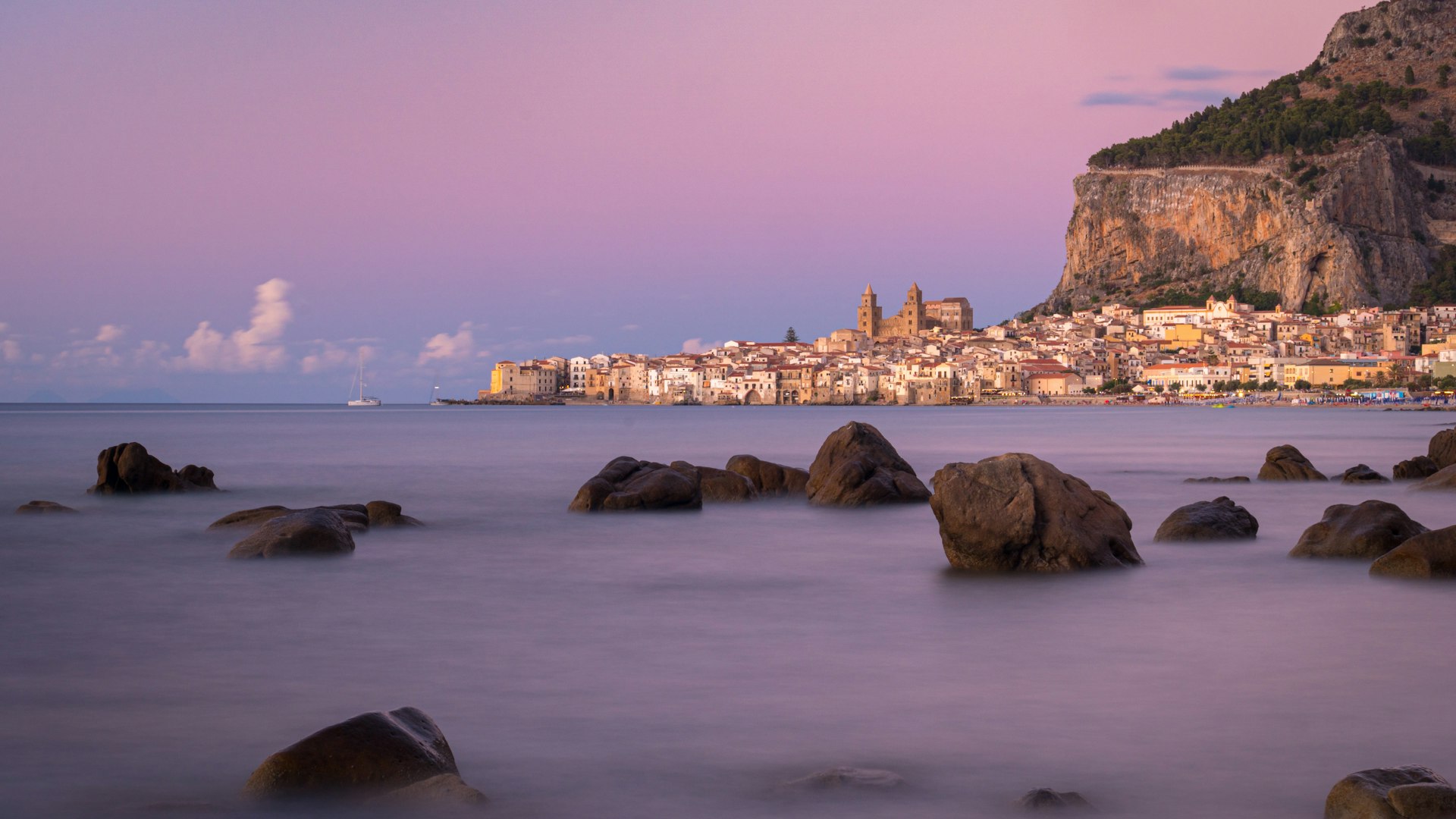
Sicily Yacht Charters

Sicily Yacht Charters

From the volcanic drama of the Aeolian Islands to the Arab-Norman harbours of the south coast, Sicily rewards charterers who approach it seriously — with a fleet ranging from nimble sailing yachts to long-range motor yachts capable of reaching Tunisia in a day.

Charter by Vessel Type in Sicily

Catamaran Charter in Sicily

Spacious twin-hull vessels offering stability, comfort, and generous deck space for the ultimate charter experience.

Sailing Yacht Charter in Sicily

Classic sailing vessels that combine timeless elegance with the thrill of wind-powered adventure.

Motor Yacht Charter in Sicily

Powerful luxury vessels delivering speed, sophistication, and effortless cruising across any waters.

Sicily sits at the intersection of three sea basins — the Tyrrhenian to the north, the Ionian to the east, and the Strait of Sicily opening south towards North Africa — which means a single charter can move through genuinely distinct sailing environments within the same week. The island is large enough that circumnavigating it in under ten days is ambitious; most charterers anchor on a defined stretch of coastline and explore it properly rather than race around the perimeter.

What distinguishes a Sicilian charter from its better-publicised Italian neighbours is the density of history at water level. You anchor off Greek temples at Agrigento's Valle dei Templi within sight of the sea, row a tender into sea caves cut through Phoenician rock, and tie up in medieval fishing ports that have been provisioning vessels since the Roman grain trade. The cuisine, meanwhile, is its own category — not a regional variation of Italian cooking but a distinct tradition shaped by Arab, Norman, and Greek influences that no amount of mainland Italian cooking can replicate.

Why Charter in Sicily

Sicily's northern and eastern coasts offer the most technically varied sailing in the central Mediterranean. The Aeolian archipelago, lying roughly 25 miles north of Milazzo, generates its own localised wind patterns; the Tramontane and the Maestrale funnel between the islands creating acceleration zones that reward experienced sailors while the anchorages between Lipari, Panarea, and Filicudi are sheltered enough for a fleet of catamarans. The Ionian coast runs almost dead straight from Messina south to Syracuse, carrying reliable summer thermals in the afternoon that make coastal passages efficient and predictable.

The south and west coasts remain genuinely underchartered relative to their quality. The coastline between Marsala and Sciacca includes the Stagnone lagoon — a shallow, wind-swept expanse that is one of the finest kitesurfing and dinghy-sailing grounds in Europe, but also contains the Phoenician island city of Motya, accessible only by shallow-draught tender. The Egadi Islands off Trapani, where the final naval battle of the First Punic War was fought in 241 BC and where archaeologists are still recovering bronze rams from the seabed, offer crystalline water and a fraction of the visitor numbers that Capri or the Amalfi Coast attract.

For motor yacht charterers, Sicily acts as a practical staging post on longer Mediterranean itineraries. Palermo and Catania both have serious commercial port infrastructure that supports refuelling and provisioning for offshore passages, and the distance from Palermo to Cagliari in Sardinia or to the Bay of Tunis is manageable in a single overnight run. The island's airports — Palermo Falcone-Borsellino and Catania Fontanarossa — receive direct flights from most European hubs, making embarkation logistics considerably simpler than for many comparable Italian destinations.

Sicily Highlights

1

The Aeolian Islands (Isole Eolie) — Seven volcanic islands north of Milazzo, each with a distinct character. Stromboli's near-constant eruptions are visible from the sea after dark; Panarea's tiny port has long attracted an upmarket Italian crowd; Alicudi and Filicudi remain genuinely remote. The passage from Milazzo to Lipari takes roughly four hours under sail in a reliable Maestrale.

2

Cala Rossa, Favignana (Egadi Islands) — The largest of the three Egadi Islands, with a deeply indented cove on its eastern side that holds a dozen yachts in clear, shallow water over white sand. The island's historic mattanza tuna fishery has largely ceased, but the dried-tuna processing plant has been converted into an excellent marine museum worth visiting by tender.

3

Syracuse (Siracusa) and Ortigia — The old city of Ortigia occupies a small island connected to the mainland by a short bridge, with a working marina at the Marina di Ortigia. The Greek theatre, the Ear of Dionysius, and the Fountain of Arethusa are all within walking distance of the quay. Arriving by sea from the south, the entrance to the Grand Harbour past Fort Vigliena is a serious piece of maritime history.

4

Taormina anchorage and Isola Bella — There is no marina at Taormina itself; yachts anchor off or use the small harbour at Naxos, two miles south. Isola Bella is a tiny islet connected to the beach by a narrow gravel bar, surrounded by a marine reserve with good snorkelling. The town above, 200 metres up on a cliff, is reached by cable car from the beach.

5

Marsala and the Stagnone Lagoon — The lagoon between the mainland and the island of Mozia (ancient Motya) is rarely more than a metre deep, accessible to shallow-draught vessels. The salt pans alongside it, still worked by hand and punctuated by 16th-century windmills, are among the most visually arresting landscapes in the western Mediterranean. Marsala's historic Rallo and Pellegrino wineries are within easy reach of the port.

6

Scala dei Turchi, near Agrigento — A white marl cliff eroded into a natural staircase rising from the sea, accessible by tender from a coastal anchorage. The surrounding coastline is undeveloped and offers good holding in sand in settled southerly conditions. Combined with a morning visit to the Valley of the Temples, this stretch of the south coast justifies at least two nights.

7

Capo Milazzo and Tindari — The promontory at Milazzo is the standard departure point for Aeolian passages, but the coast running west towards Tindari is overlooked. The sanctuary of the Black Madonna at Tindari sits directly above a lagoonal sandbar — the Marinello lagoons — that forms and reforms each season and is best appreciated from a tender or paddleboard at sea level.

When to Sail

Sicily's charter season runs from early May through late October, with high summer delivering the most settled conditions but shoulder months offering more comfortable temperatures and less pressure on popular anchorages.

High Season (Jun-Sep)

The Maestrale — the north-westerly that dominates Sicilian summer weather — blows most reliably between June and August, typically building in the afternoon and easing overnight, which suits coastal passage-making well. Sea temperatures reach 26-28°C by August. The downside is that Panarea, Taormina, and the Egadi Islands are under significant pressure from charter traffic in July and August; booking preferred anchorages and marina berths well in advance is essential. The Scirocco, the hot southerly from North Africa, makes occasional appearances in June and September, bringing haze and a sharp rise in humidity, but these episodes rarely last more than two to three days.

Shoulder Season (May, Oct)

May and October are arguably the finest months to charter in Sicily for those with flexibility. Temperatures sit between 18-24°C, the water is swimmable from mid-May onwards, and the Aeolian Islands are accessible without the August crowds. Wind patterns are less predictable in these months — the Libeccio and Tramontane both make stronger appearances — so itinerary flexibility matters. October in particular offers exceptional visibility, autumnal light across the hillside vineyards visible from the water, and the beginning of the fresh tuna and swordfish season in the Strait of Messina. Marina availability is rarely a problem, and provisioning in Palermo and Catania markets reaches a seasonal peak as local produce hits its best.

Choosing the Right Yacht

Catamarans are the most practical choice for the majority of Sicilian itineraries, particularly for families or groups who want to use the yacht as a base rather than a means of passage-making. The shallow drafts achievable on a Bali 4.2 or Bali 4.4 open up anchorages in the Stagnone and around the Egadi Islands that are simply inaccessible to keelboats drawing more than two metres. The wide beam provides genuinely usable outdoor living space, which matters in a destination where evening meals on deck are a daily event from June onwards. For the Aeolian circuit specifically, a catamaran's ability to anchor in slight swell without the rolling that affects monohulls makes overnight stays at open anchorages like those on the north side of Stromboli considerably more comfortable. Sailing yachts reward those doing the longer coastal passages — down the Ionian coast from Messina to Syracuse, or the offshore run to the Egadi Islands from Palermo. The afternoon Maestrale provides consistent reaching conditions on these routes and a well-found Bavaria or Beneteau in the 45-50 foot range handles them efficiently with a modest crew. Motor yachts, including the Azimut and Aicon models represented in the SelectYachts Sicily fleet, come into their own for charterers treating Sicily as part of a wider itinerary encompassing Sardinia, Malta, or the Calabrian coast, where the ability to cover ground quickly between destinations and maintain schedule regardless of wind direction has obvious practical value.

Seven Days from Palermo to Syracuse via the Aeolian Islands

A suggested week-long charter route

Day 1

Board in Palermo at the Porto di Palermo or La Cala, the small historic harbour in the city centre. Spend the afternoon provisioning at the Ballarò or Vucciria markets — some of the finest fresh produce sourcing in the Mediterranean — before departing eastward along the Tyrrhenian coast. Anchor overnight in the sheltered bay below Cefalù, with time to walk the Norman cathedral before dinner.

Day 2

Early departure from Cefalù for the passage to Milazzo (approximately 60 nautical miles), arriving mid-afternoon. Milazzo's marina, run by Porto di Milazzo, handles most charter traffic departing for the Aeolians. Refuel, top up water, and brief the crew on the following morning's crossing. Dinner ashore in Milazzo town.

Day 3

Cross to Lipari (roughly 25nm, three to four hours under the Maestrale). Lipari town's commercial port accommodates visiting yachts on the outer quays; the Aeolian Archaeological Museum above the castle is genuinely world-class for its collection of Neolithic and Bronze Age material. Afternoon sail south-west to anchor off Salina — specifically the bay at Pollara, the location used in filming Il Postino, with dramatic cliffs on three sides.

Day 4

Full day in the northern Aeolians. Morning snorkel at Panarea's Cala Junco, a cove on the island's south side with Bronze Age village ruins on the headland above the water. Afternoon passage to Stromboli for a sunset anchorage off the Sciara del Fuoco — the island's active lava channel — watching the eruptions after dark from the deck. Overnight at anchor off Stromboli's Scari beach, or return to Panarea for more shelter.

Day 5

Return south through the Messina Strait, using the north-going flood current where timing permits (the strait carries up to 3 knots on spring tides and the timing significantly affects passage time). Continue south down the Ionian coast to Taormina, anchoring off Isola Bella or taking a berth at the Naxos marina. Cable car to Taormina for dinner at one of the restaurants on the Corso Umberto.

Day 6

Passage south along the Ionian coast to Syracuse (approximately 70nm, best done as a morning start to arrive before afternoon sea breeze peaks). Enter through the Porto Grande — the Grand Harbour — and berth at Marina di Ortigia. Afternoon walk through Ortigia: the Piazza del Duomo built around a Doric temple, the fish market at Porta Marina, and the freshwater spring at Arethusa where fresh water meets salt.

Day 7

Final morning in Syracuse — the archaeological park containing the Greek theatre and the quarries is two miles from the marina and best visited early before heat builds. Depart by noon if the charter end point requires repositioning northward, or spend a final afternoon at anchor in Cala Rossa south of Syracuse before disembarkation. Catania Fontanarossa airport is 55km from Syracuse by road.

Local Tips

  • Italian customs (Dogana) formalities apply within Sicily as in the rest of Italy; non-EU flagged yachts entering from outside the Schengen area must report to the Guardia di Finanza at first port of entry. Palermo and Catania are the most straightforward entry points. Keep crew lists and ship's papers immediately accessible — checks at smaller ports like Milazzo are routine during peak season.
  • Provisioning quality varies sharply by location. Palermo's Ballarò market and Catania's La Pescheria fish market are among the best in the Mediterranean for fresh produce, local cheeses, and swordfish from the Strait. In the Aeolian Islands, resupply is expensive and limited — carry sufficient provisions from the mainland and top up with local capers from Pantelleria, available at Lipari shops, and Malvasia wine from the Salina producers.
  • Marina reservations in the Aeolians are not optional in July and August. Lipari, Panarea, and Vulcano's Porto di Levante all have limited berthing and significant demand from Italian domestic charter traffic. Book through the respective marina offices a minimum of two to three weeks ahead. The free anchorages are technically available but swell from passing Scirocco events can make them uncomfortable overnight.
  • The Strait of Messina deserves specific navigational attention. The current runs north for roughly six hours and south for six hours on a semi-diurnal cycle, reaching 3 knots at spring tides in the narrowest section off Punta Pezzo. Passing with a fair tide saves two to three hours on a 60nm sailing yacht and makes the difference between a comfortable reach and a frustrating beat against wind-over-tide chop. The Port Authority at Messina maintains VHF working channel 16; commercial traffic has right of way and moves fast through the strait.
  • Eating ashore follows strict local rhythms. Lunch service ends firmly at 15:00 in most Sicilian restaurants outside the tourist centres; arriving at 14:30 in a working fishing port like Sciacca or Marsala will find the kitchen closed. For serious dining — arancini, pasta con le sarde, fresh sea urchin with pasta at Augusta — reservations are expected at any restaurant worth eating in. Tipping follows the continental norm of rounding up rather than a percentage-based gratuity.
  • Fuel availability along the south coast between Agrigento and Gela is limited; the nearest reliable bunkering for larger motor yachts on that stretch is at Porto Empedocle. Plan tank levels carefully when transiting the south coast in either direction, and confirm in advance whether the fuel dock at your next port is operational out of high season.

Frequently Asked Questions

Do I need a licence to charter a yacht in Sicily+
For bareboat charters of vessels over 6 metres, Italian maritime law requires the skipper to hold a recognised coastal or offshore sailing licence. The International Certificate of Competence (ICC) endorsed for coastal waters is generally accepted, as is a Day Skipper or equivalent RYA qualification. For motor yachts above a certain power threshold, a specific powerboat endorsement is required. Crewed charter clients are unaffected — the professional skipper holds the necessary certifications. If in doubt about your specific qualifications, contact SelectYachts before confirming a bareboat booking.
What is the best base port for a Sicilian charter+
The answer depends on your priority route. Palermo is the best starting point for the Aeolian Islands circuit and the western coast including the Egadi Islands; it also has the best flight connections from northern Europe. Catania is the more practical base for Ionian coast itineraries running south to Syracuse and Ragusa. Milazzo is used almost exclusively as a departure point for the Aeolians and is best treated as a one-night stopover rather than an embarkation port. For the south and west coasts, Marsala or Trapani are usable bases if your flights work via Palermo with a transfer.
Are the Aeolian Islands suitable for catamarans+
Yes, and in many respects a catamaran is the preferred vessel for the Aeolian circuit. Shallow draft allows access to bays that exclude deeper-keel monohulls, and the platform stability at anchor is significantly better when a northerly Tramontane sends a residual swell through the anchorages. The main practical consideration is marina space — Aeolian ports are designed around fishing boats and smaller yachts, and a catamaran above 14 metres beam may struggle to find a berth at Panarea or Vulcano's Porto di Levante in August. In that case, swinging on anchor is both feasible and often preferable.
Can I sail from Sicily to Malta or Tunisia on a charter yacht+
Yes, subject to the charter contract specifically permitting international passages — this needs to be confirmed with SelectYachts and the yacht owner before departure. The passage from Marsala to Valetta (Malta) is approximately 90 nautical miles; from Trapani to Tunis it is around 100nm. Both are realistic day passages for a motor yacht and comfortable overnight passages for a sailing yacht. Customs and immigration procedures apply at both Malta (EU, Schengen border) and Tunisia (non-EU, visa requirements vary by nationality). Additional insurance endorsements and a change-of-port notification to the Italian Capitaneria may be required.
What should I expect to pay for a week's charter in Sicily+
The SelectYachts Sicily fleet covers a wide range of budgets and vessel types. Entry-level bareboat catamarans and sailing yachts start well below EUR 5,000 per week, making Sicily accessible to charterers on modest budgets who are willing to self-skipper. Mid-range crewed or skippered charters in the EUR 8,000 to EUR 20,000 range represent the largest part of the market and access a strong selection of quality yachts. At the top of the market, fully crewed motor yachts and high-specification sailing yachts are available well above EUR 50,000 per week. All figures are base charter rate; APA (Advance Provisioning Allowance) for fuel, marina fees, provisioning, and crew gratuity typically adds 25-30% to the base rate on crewed charters.
Is Sicily suitable for first-time yacht charterers+
Sicily is manageable for first-timers who choose the right vessel and itinerary. The coastline is well-charted, marina infrastructure is solid in the main ports, and the sailing conditions in settled summer weather are genuinely forgiving. The Strait of Messina and some of the Aeolian Island passages are not appropriate for inexperienced crews sailing without a skipper. The most practical approach for first-timers is to take a crewed charter or add a professional skipper to a bareboat booking — costs are modest relative to the overall charter budget and the difference in experience is significant. SelectYachts can advise on skippers familiar with specific Sicilian routes.

Speak to the SelectYachts team to find the right vessel for your Sicilian itinerary — whether you are planning an Aeolian circuit next month or a circumnavigation next season.

Request Your Charter

Request Your Charter

Tell us about your dream voyage and we will find the perfect yacht for you.