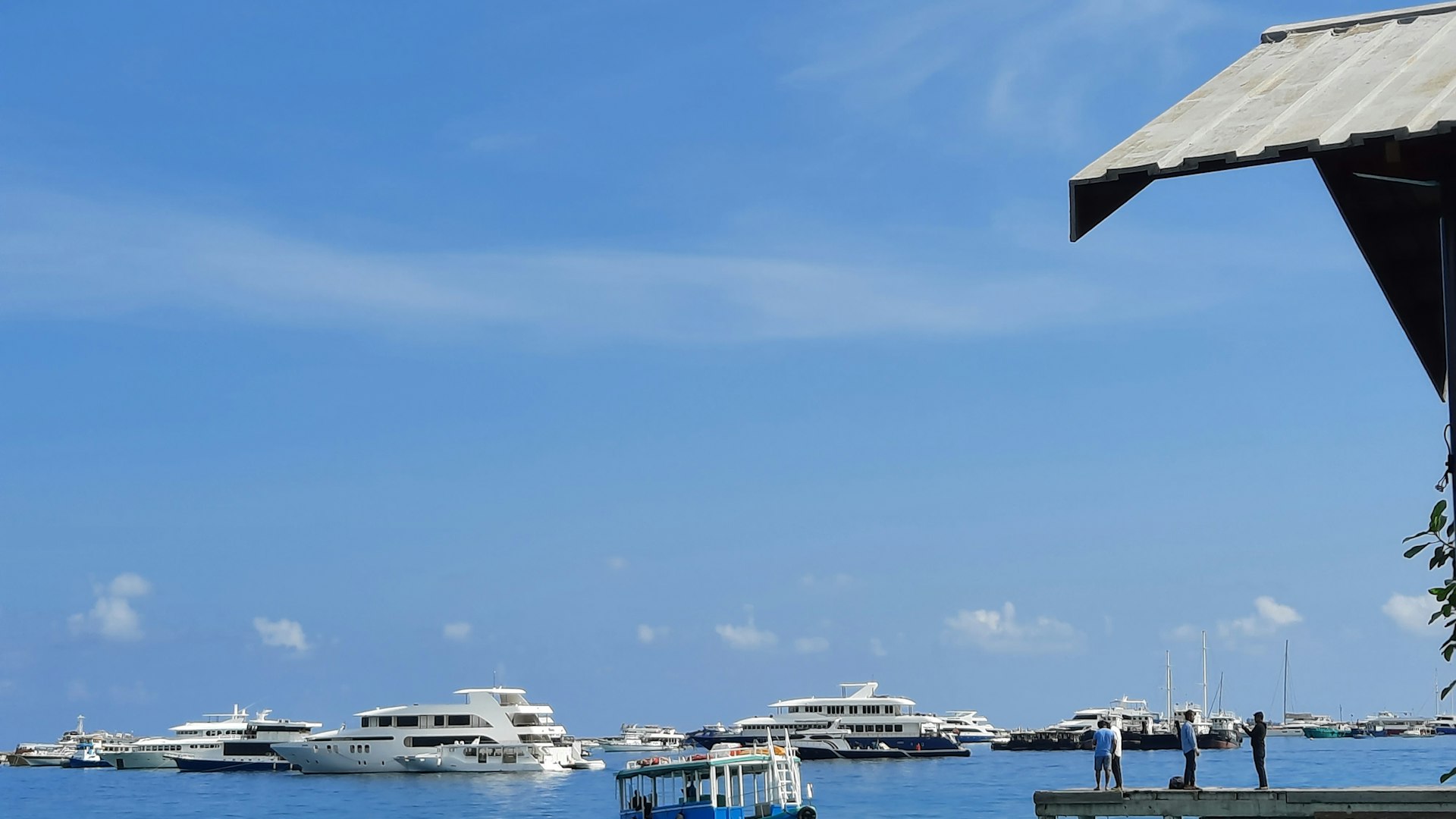
Maldives Yacht Charters

Maldives Yacht Charters

One thousand two hundred islands arranged across twenty-six natural atolls, with visibility regularly exceeding thirty metres and the Indian Ocean's most reliable flat-water diving above reef systems that begin just metres from the surface.

Charter by Vessel Type in Maldives

Catamaran Charter in Maldives

Spacious twin-hull vessels offering stability, comfort, and generous deck space for the ultimate charter experience.

Sailing Yacht Charter in Maldives

Classic sailing vessels that combine timeless elegance with the thrill of wind-powered adventure.

Motor Yacht Charter in Maldives

Powerful luxury vessels delivering speed, sophistication, and effortless cruising across any waters.

The Maldives sits astride the equator roughly 700 kilometres south-west of Sri Lanka, its atolls strung along a north-south axis across 900 kilometres of the Indian Ocean. What makes it genuinely unusual for charterers is the geography: there is almost no land above two metres, so the horizon is water in every direction, and the protected lagoons between reef systems create sheltered anchorages even during the south-west monsoon. Distances between atolls are real offshore passages, but within each atoll the sailing is flat-water motoring or gentle reaches in moderate breeze.

This is not a destination for long days under canvas. It is a destination for exceptional underwater terrain, remote sandbank picnics, and the kind of privacy that is impossible to achieve in the Mediterranean or Caribbean. Charter guests typically spend more time in the water than on it, and the itinerary logic is structured accordingly. The right yacht here is a well-equipped platform for exploration, with tenders, dive compressors, and range enough to reach the least-visited atolls in the south.

Why Charter in Maldives

The Maldives offers access that resort guests simply cannot replicate. Uninhabited outer atolls such as Huvadhu and Addu are beyond the reach of day-trip boats and seaplanes, yet a well-provisioned liveaboard can anchor off a sandbank where the nearest other vessel is twenty miles away. The reef systems in these southern atolls remain in significantly better condition than those closer to Malé, which matters if underwater quality is the primary reason for the trip.

Drift diving on the thilas — the submerged pinnacles that rise through atoll channels — is a specific and serious draw. Sites such as Maaya Thila in North Ari Atoll and Fish Head in South Ari Atoll see strong tidal flows that concentrate grey reef sharks, eagle rays, and large pelagics on a predictable schedule. A charter yacht can position precisely for the correct tidal window rather than waiting for a dive dhoni to organise twelve other guests.

Above water, the cultural experience is underrated. Local island communities on inhabited islands such as Ukulhas, Fulhadhoo, and Dhigurah offer a genuine and hospitable alternative to resort life. Charterers who take time to visit a local island for Friday prayers, a tea house lunch, or a fishing excursion gain a dimension of the country that is invisible from a resort jetty. This requires cultural sensitivity and the right briefing from your crew, but it is entirely accessible.

Maldives Highlights

1

Hanifaru Bay, Baa Atoll — a UNESCO Biosphere Reserve feeding site where manta ray numbers between July and October regularly exceed 200 individuals in a single lagoon. Access is regulated; your crew will need to coordinate with the Baa Atoll Council, and no motorised vessels may enter the bay during feeding events.

2

Maaya Thila, North Ari Atoll — widely considered one of the Indian Ocean's finest dive sites, a submerged pinnacle dropping to 35 metres surrounded by whitetip reef sharks, napoleon wrasse, and large schools of fusiliers. Best dived on an incoming tide at dawn before the dive dhonis arrive.

3

Huvadhu Atoll — the world's largest natural atoll by lagoon area, roughly 65 kilometres across, with fewer than a dozen liveaboards operating here at any time. The reef wall on the southern rim offers drift dives in near-pristine condition.

4

Addu Atoll (Seenu) — the southernmost atoll and the only one with road-connected islands, where the British RAF base at Gan left a fascinating layer of mid-twentieth century infrastructure now largely reclaimed by vegetation. The wreck of the British Loyalty, a WWII oil tanker, is diveable in 30 metres directly off Gan.

5

North Malé Atoll sandbanks — the uninhabited sandbars between Vaadhoo and Nakachchaafushi offer straightforward overnight anchoring close enough to Velana International Airport for embarkation, with the added phenomenon of bioluminescent phytoplankton visible on dark nights between July and February.

6

Rasdhoo Atoll — a compact atoll north of Ari with the channel site known locally as Hammerhead Point, where scalloped hammerhead sharks aggregate in the early morning at around 30 metres depth, making it worth the 04:30 dive briefing.

7

Local island Ukulhas (Alif Alif Atoll) — one of the cleanest and most visitor-ready local islands, with a community-run beach, reef conservation programme, and a genuinely good fish curry available at the island's tea houses on Friday lunchtime.

When to Sail

The Maldives has two distinct monsoon seasons: the north-east monsoon (December to April) brings the clearest skies and calmest seas, making it the preferred charter window, while the south-west monsoon (May to November) brings higher rainfall and swell but remains operationally viable for experienced crews choosing the right atolls.

High Season (Jun-Sep)

Counterintuitively, the south-west monsoon peak months of June to September are popular for a specific reason: manta ray aggregations in areas such as Hanifaru Bay (Baa Atoll) peak between July and October, when plankton blooms driven by the monsoon upwelling concentrate hundreds of reef mantas in a single feeding site. The south-west swell makes passages between atolls rougher, particularly north of Malé, and afternoon squalls are frequent. Charterers focusing on southern atolls such as Huvadhu and Addu find more natural shelter, and visibility underwater, though slightly reduced from the December peak, remains well above 20 metres on most sites.

Shoulder Season (May, Oct)

May and October represent the transitions between monsoons, with variable winds, occasional heavy rain, and a mix of conditions that experienced skippers navigate by atoll choice rather than avoidance. May sees the south-west monsoon establishing, so the northern atolls deteriorate first. October is the more reliable of the two: the south-west monsoon is weakening, seas are settling, and you can often find windows of exceptional clarity and calm. Charter rates are typically lower in these months, and the atolls are noticeably less crowded with liveaboard dive vessels.

Choosing the Right Yacht

The Maldives fleet is dominated by purpose-built or custom motor yachts in the 24 to 38 metre range, and for good reason. Atoll navigation involves shallow reef passes, GPS waypoint precision, and the ability to anchor in three to eight metres over sand — capabilities that suit a motor yacht with a competent local crew member on board. The absence of meaningful sailing wind inside most atolls makes the sailing performance of a monohull largely irrelevant for the core itinerary. Motor yachts with a good tender fleet, dive compressors, and ideally a chase boat are the most effective platform. Catamarans bring genuine advantages for larger groups given the deck space and stability at anchor, and the reduced draft is a practical asset in shallow lagoon anchorages. Two catamarans are available in the fleet and are a strong choice for families or groups who prioritise above-water comfort alongside diving. What matters most regardless of hull type is crew local knowledge: the passes, currents, and sand anchor spots in outer atolls are not fully captured on any chart, and a skipper with Maldivian atoll experience is worth more here than in almost any other destination.

Ten Nights from Malé Through Ari and Baa Atolls

A suggested week-long charter route

Day 1

Embark at Malé Marina (Malé Commercial Harbour or the dedicated charter pier at Hulhumalé, depending on your vessel). Immigration formalities and provisioning complete, depart in the afternoon for the 30-nautical-mile passage south-west to North Ari Atoll. Anchor off the sandbank at Mathiveri for the first night.

Day 2

Morning dive at Maaya Thila on the incoming tide. The site is best before 08:00 when visibility is optimal and dive dhoni traffic is minimal. Surface interval on the yacht, then a second dive at Broken Rock. Reposition in the afternoon to Ukulhas island for a local island walk and tea house visit.

Day 3

Full day in South Ari Atoll, focusing on Fish Head (Mushimasmingili Thila), known for its resident population of grey reef sharks and regular sightings of whale sharks year-round. The atoll's western rim offers a second afternoon dive with less current.

Day 4

Transit day north-west toward Baa Atoll, a passage of roughly 45 nautical miles. Snorkelling stop at a remote reef en route. Anchor in the lee of Fulhadhoo island, one of the more atmospheric inhabited islands in the atoll, for the night.

Day 5

Hanifaru Bay — coordinate the early morning entry with Baa Atoll Council rangers. Snorkelling only inside the bay; fins and masks rather than dive equipment. Manta activity typically peaks mid-morning on a rising tide between July and October. Afternoon free for kayaking or paddleboarding in the lagoon.

Day 6

Explore the Baa Atoll outer reef on the north-western edge, then return south-east toward Rasdhoo Atoll via an overnight passage. Arrive Rasdhoo at dusk; crew to brief the early morning hammerhead dive.

Day 7

Pre-dawn departure for the Hammerhead Point dive at Rasdhoo — descent to 28-32 metres in the channel, positioning on the sandy bottom before the school moves through with the current change. Rest of the day at anchor with light activities and a sunset beach barbecue on a nearby sandbank.

Day 8

Free cruising day in North Malé Atoll, using the yacht's tender to access the shallow reef passes north of Vaadhoo. Evening anchor in position for bioluminescent water viewing after midnight — the tender ride through the glowing wake is one of the more memorable non-diving experiences in the Maldives.

Day 9

Final full day. Return toward Malé with a morning snorkel at Banana Reef, one of the most accessible quality reefs in the North Malé atoll. Afternoon at a private sandbank for lunch and swimming. Final dinner aboard at anchor.

Day 10

Disembarkation at Hulhumalé or Malé harbour. Seaplane connections to international departures operate from a terminal adjacent to Velana International Airport; tender transfer to the seaplane dock can be arranged with 48 hours' notice.

Local Tips

  • Cruising permit and advance planning — all charter yachts must hold a valid Maldives cruising permit issued by the Ministry of Transport. Applications require the vessel's registration, insurance, and a crew list, and should be submitted at least three to four weeks before arrival. Your broker handles this routinely but do not assume it is automatic.
  • Alcohol regulations — the Maldives prohibits alcohol on inhabited local islands. Provisions for the yacht must be bonded on board and consumption is permitted on the vessel and at licensed resort islands only. Pre-stock the yacht fully at the point of embarkation; restocking mid-charter is not straightforward.
  • Provisioning — Malé has reasonable provisioning options for dry goods and packaged products, but fresh produce quality is variable and Western luxury provisions are limited. Most serious charterers pre-order provisions through their crew or a local agent and supplement with fresh fish purchased directly from local fishing dhonis encountered at anchor, which is both the freshest and most enjoyable way to source the catch.
  • Local currency and tipping — the Maldivian Rufiyaa is the local currency but US dollars are universally accepted. Tips for local fishing trips, island guides, and dhoni crews are appropriate in dollars. Bargaining is not part of the local commercial culture and is considered impolite.
  • Cultural dress codes — outside of resort islands and the yacht itself, conservative dress is expected. Women should cover shoulders and knees on local islands, and both sexes should be aware that public displays of affection are inappropriate. Your crew will brief you specifically, but the rule of thumb is: arriving at a local island by tender, dress as you would for a smart-casual lunch ashore.
  • Waste and reef etiquette — Maldivian regulations require that all waste is retained on board and disposed of at Malé. Anchoring on coral is a serious offence and sandy patches in atoll lagoons should always be sought. Sunscreen regulations are increasingly enforced at protected marine areas including Hanifaru Bay; carry reef-safe products.

Frequently Asked Questions

Do I need prior sailing experience to charter in the Maldives+
No. All charters in the Maldives are fully crewed, and the vessel's licensed captain holds the required local cruising permits and navigational responsibility. Charterers are guests, not crew. What you do need is clarity on your priorities — diving certification levels, activity preferences, and desired remoteness — so the captain can plan the itinerary accordingly.
Is the Maldives suitable for families with children+
Yes, and increasingly so. The flat-water lagoon anchorages make catamarans and larger motor yachts very stable platforms for younger guests. Snorkelling quality even at two to three metres depth is exceptional, and children's snorkel and basic diving programmes are available through resort dive centres accessible by tender. The main consideration is sun and heat management; the equatorial UV index is extreme year-round.
Can we visit local islands or are we restricted to resort islands+
You can visit designated local islands — those without resort infrastructure — provided you respect dress codes and local customs. The government has actively developed a list of 'tourist-approved' local islands and your captain will have current guidance. Some islands require a small harbour fee payable to the island council.
What is the typical sea state for passages between atolls+
Within atolls, conditions are generally flat or light chop. Inter-atoll passages cross open ocean exposed to the Indian Ocean swell, and can reach two to three metres during the south-west monsoon from May to October. The north-east monsoon season (December to April) produces the calmest inter-atoll conditions. Your captain will assess conditions for any passage of more than thirty nautical miles.
How far in advance should we book a Maldives charter+
For the December to April peak season, six to twelve months in advance is realistic for the best vessels. The manta season (July to October) in Baa Atoll also books well ahead, particularly in August. Shoulder months of May and October have more availability. The fleet in the Maldives is genuinely limited — around fourteen vessels at SelectYachts alone — so this is not a destination where last-minute availability is reliable.
What is included in the weekly charter fee+
The base charter rate covers the vessel and crew. Fuel, provisioning, port and cruising permit fees, and diving equipment rental are typically additional and quoted as an Advance Provisioning Allowance (APA), usually 30 to 35 per cent of the base rate in the Maldives due to fuel costs for motoring between atolls. Your charter agreement will itemise these precisely. Ask your broker for a realistic total cost estimate before comparing headline rates.

Speak with a SelectYachts specialist to match your dates and priorities to the right vessel in our Maldives fleet.

Request Your Charter

Request Your Charter

Tell us about your dream voyage and we will find the perfect yacht for you.